|
Plank
Road Folk Music
Society
|
|
|
Plank
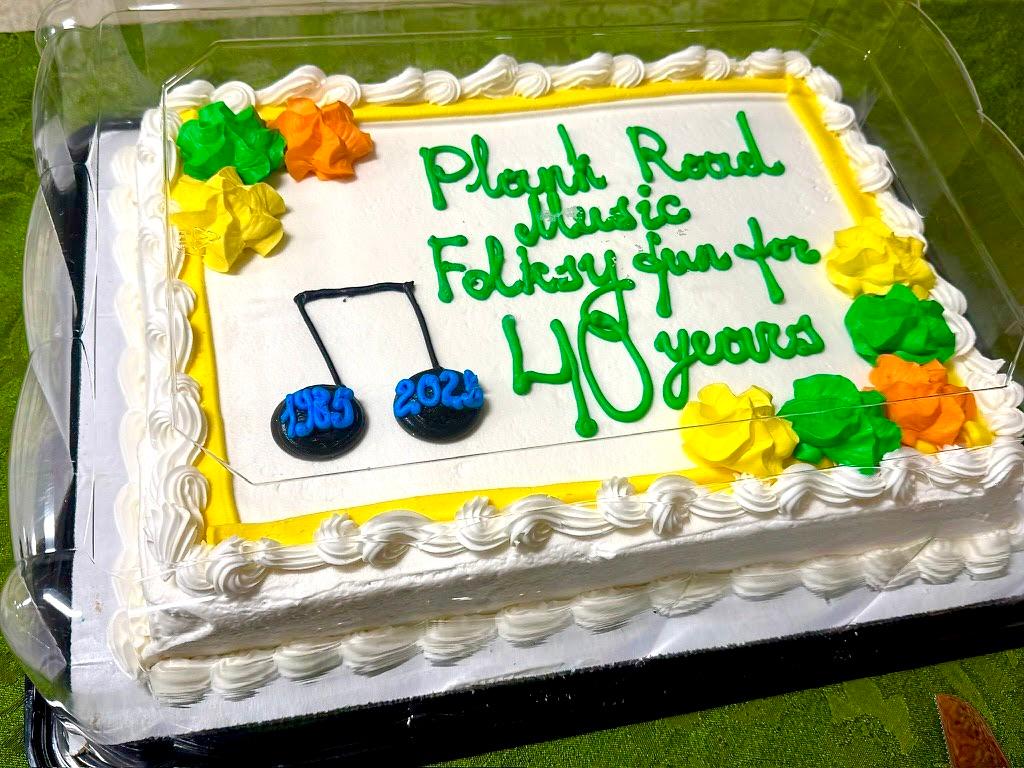
Road’s 40th Anniversary
Party
Music,
food, history, tributes
. . . and more
music!
|
|
|
Saturday,
June 14, 2025 . .
.
There
was a lot going on that
day: The weather was
beautiful, there were
errands to run, lawns to
mow, and family events
to attend. (Not to
mention parades and
protests around the
country.)
But
the big event for
friends of Plank Road
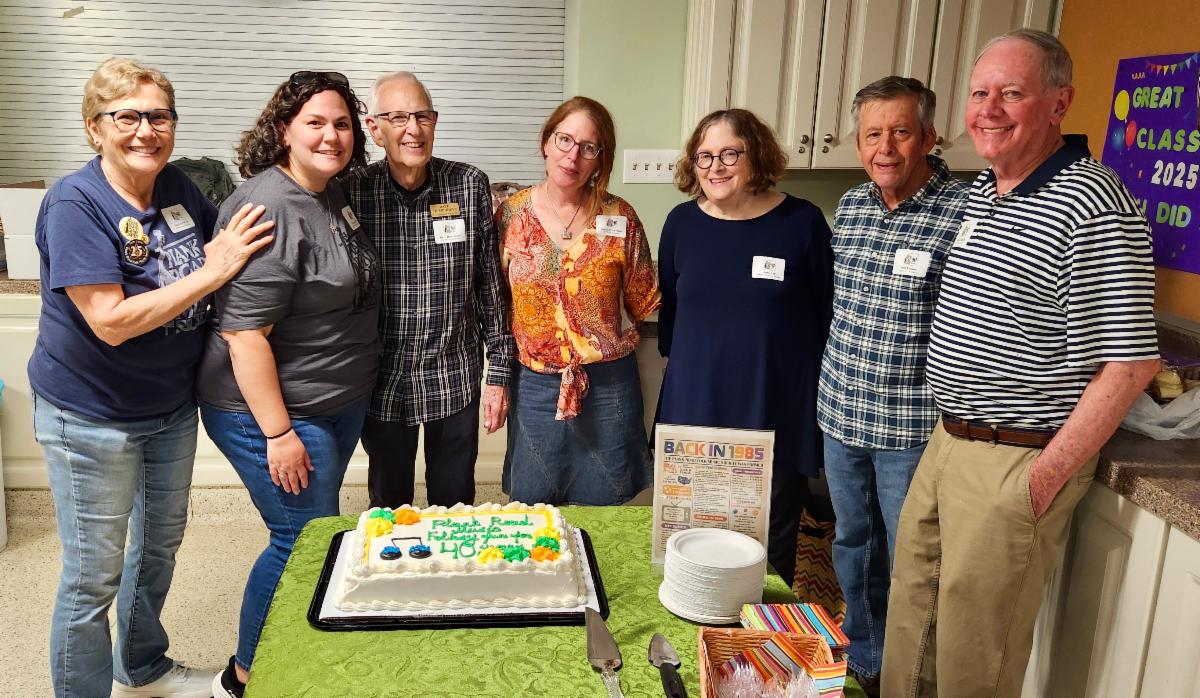
was our 40th Anniversary
party!
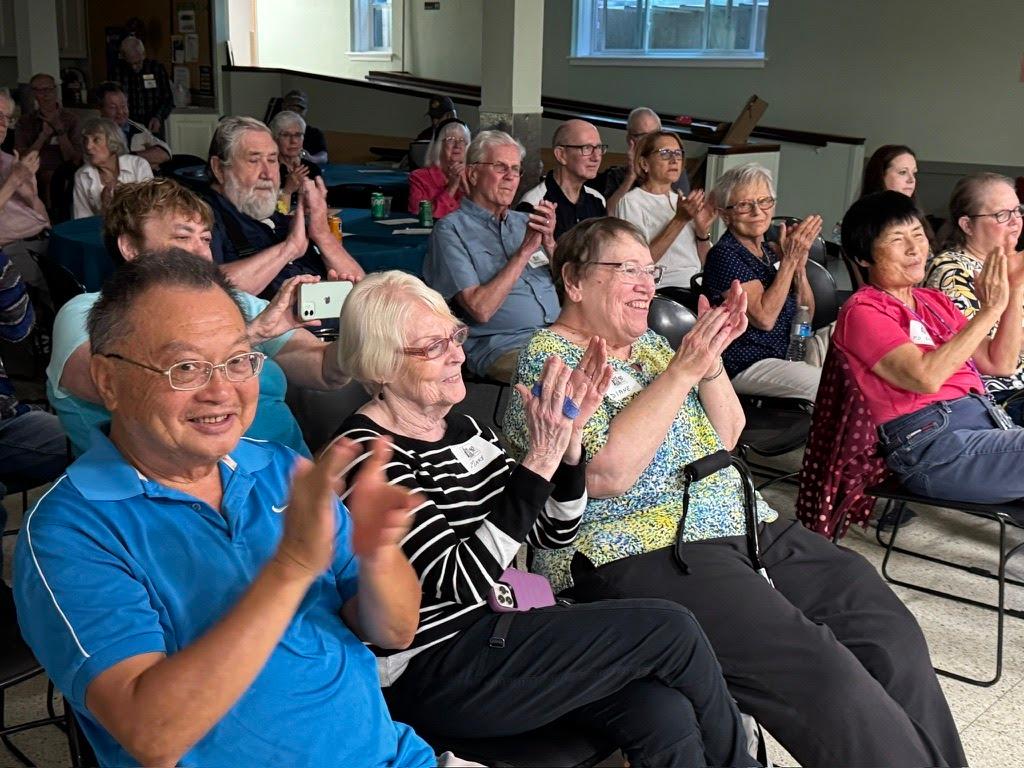
After
several months of
planning and lots of
hard work by many
dedicated people, it all
came together with
music, food, happy
reunions and memories
for an enthusiastic and
appreciative
crowd.
|
|
|
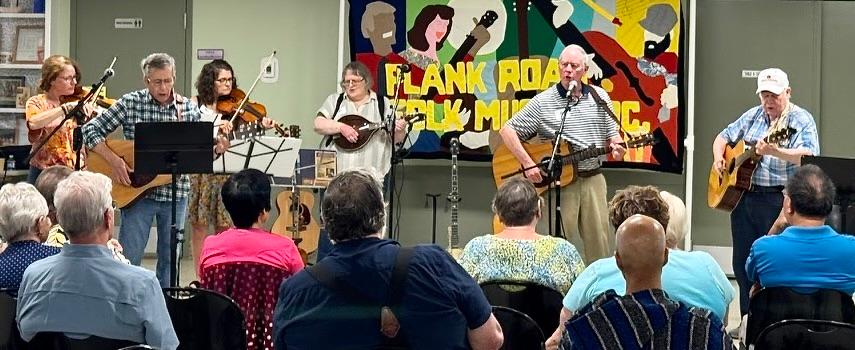
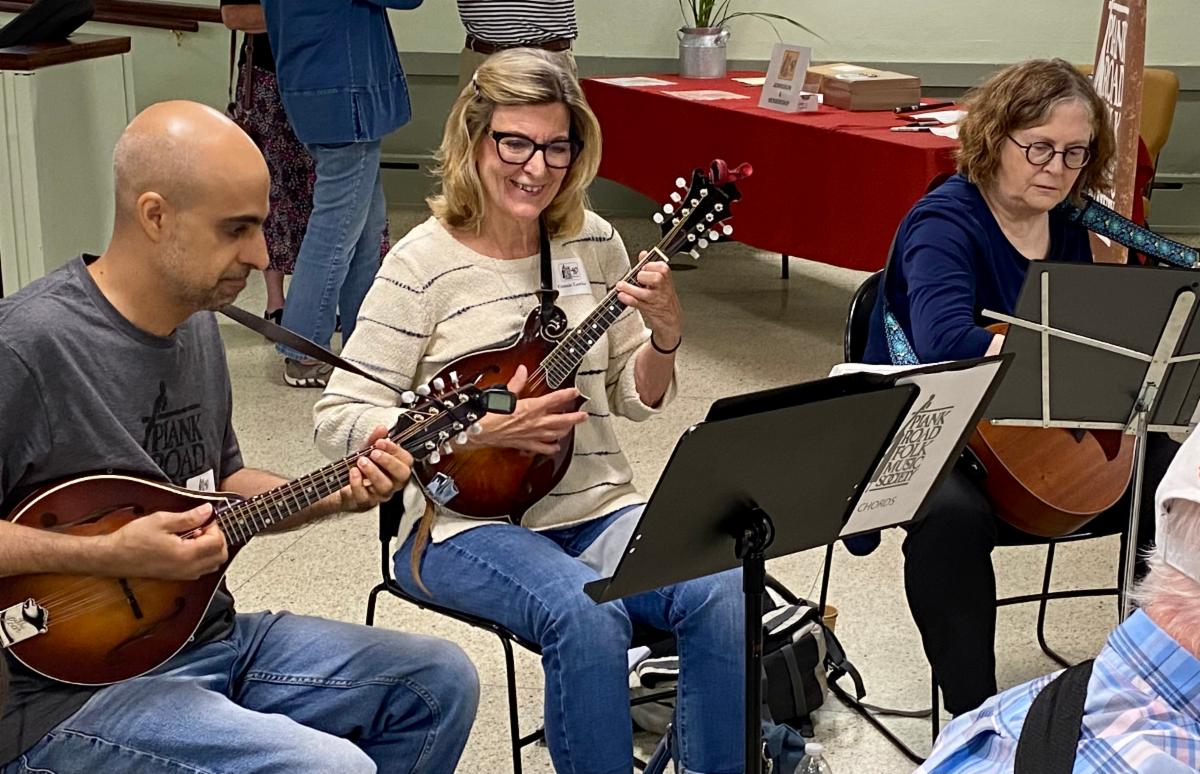
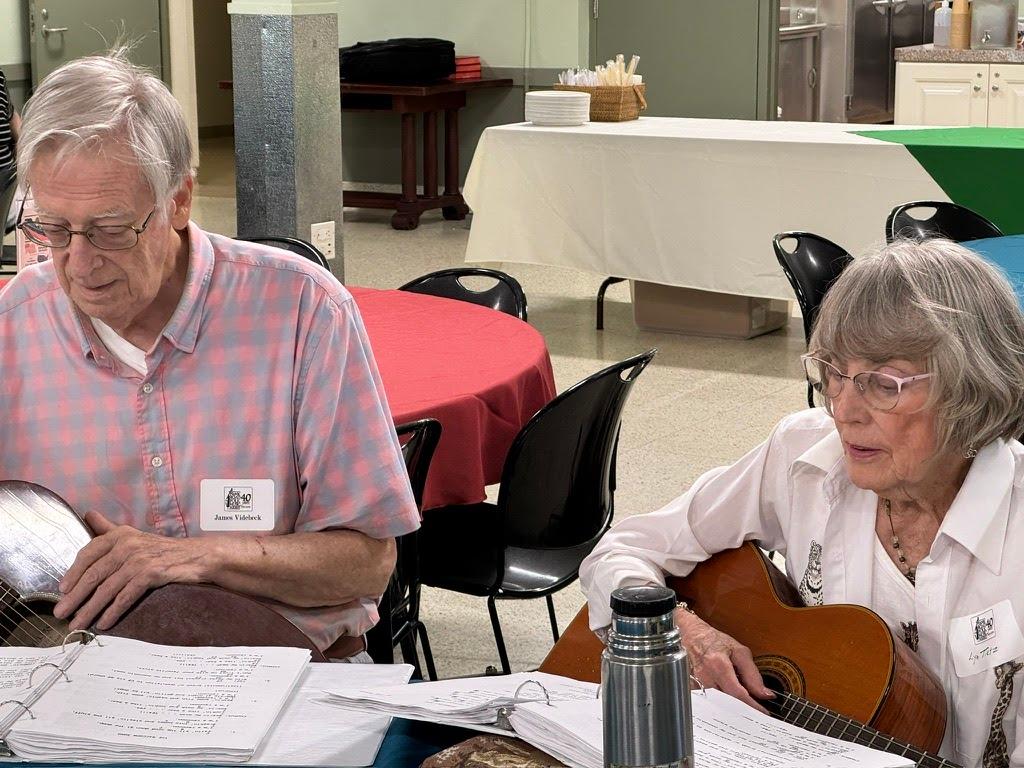
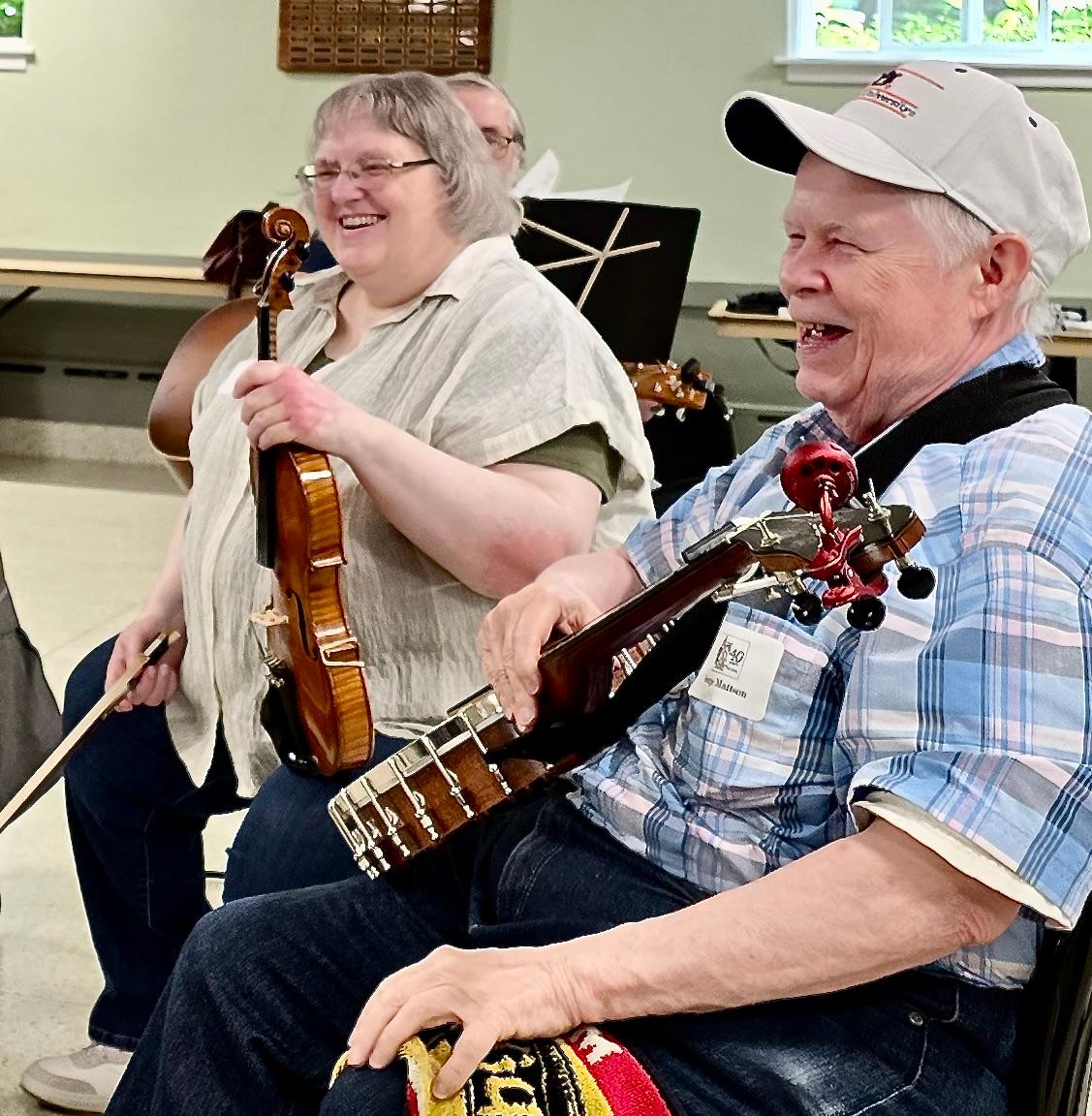
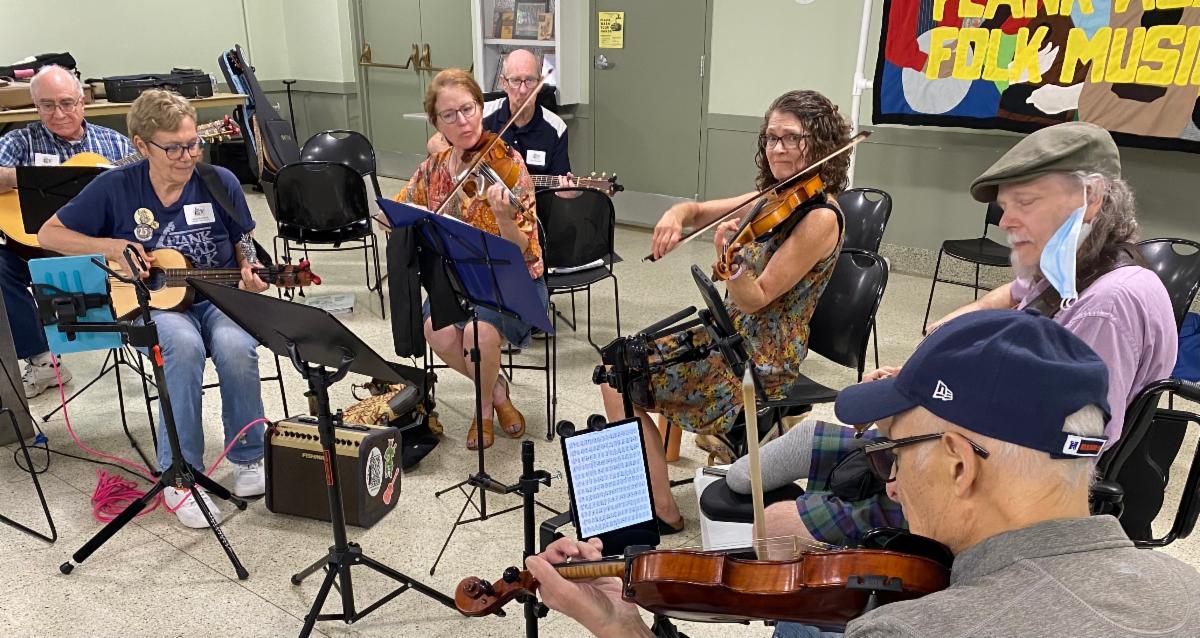
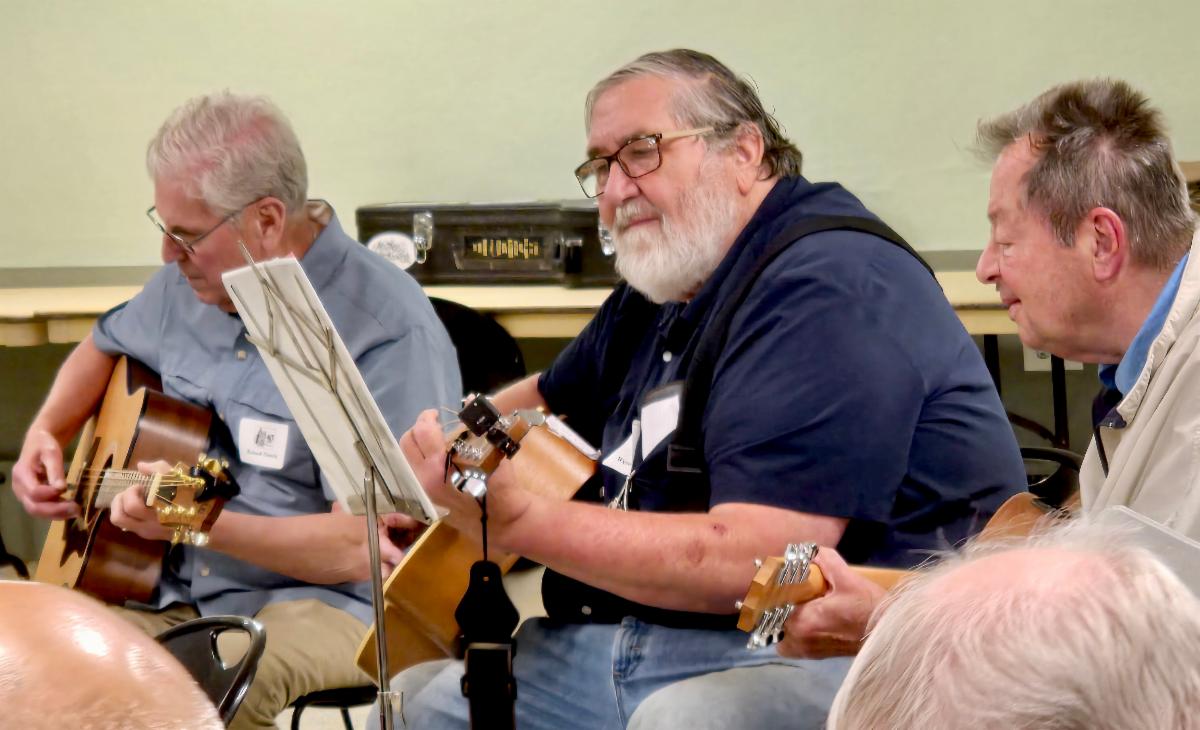
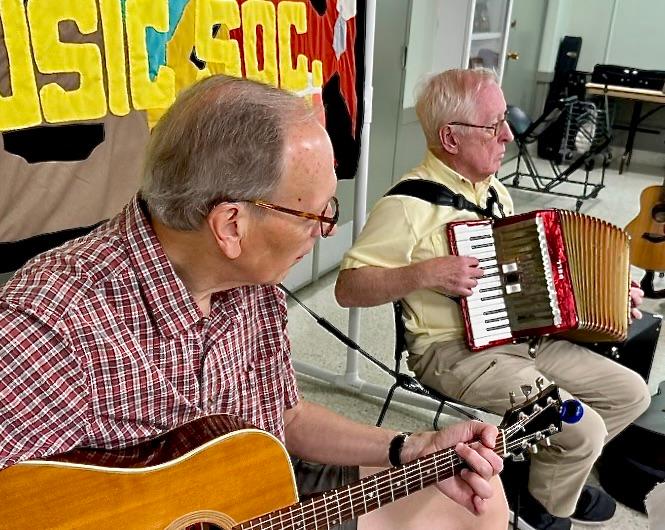
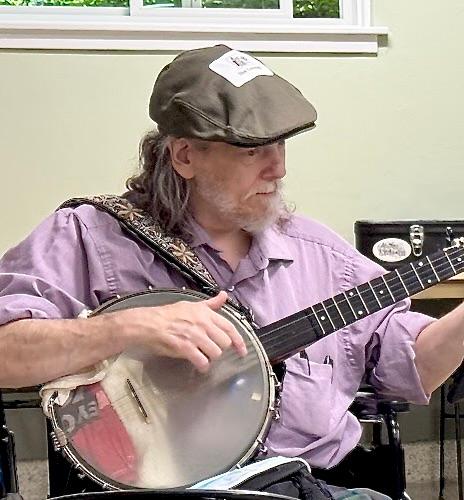
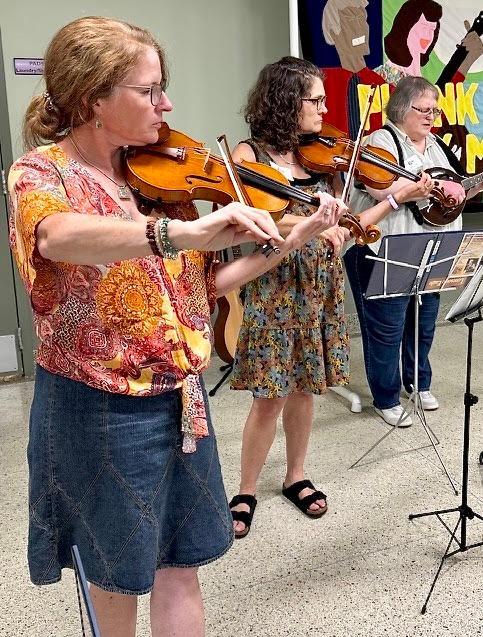
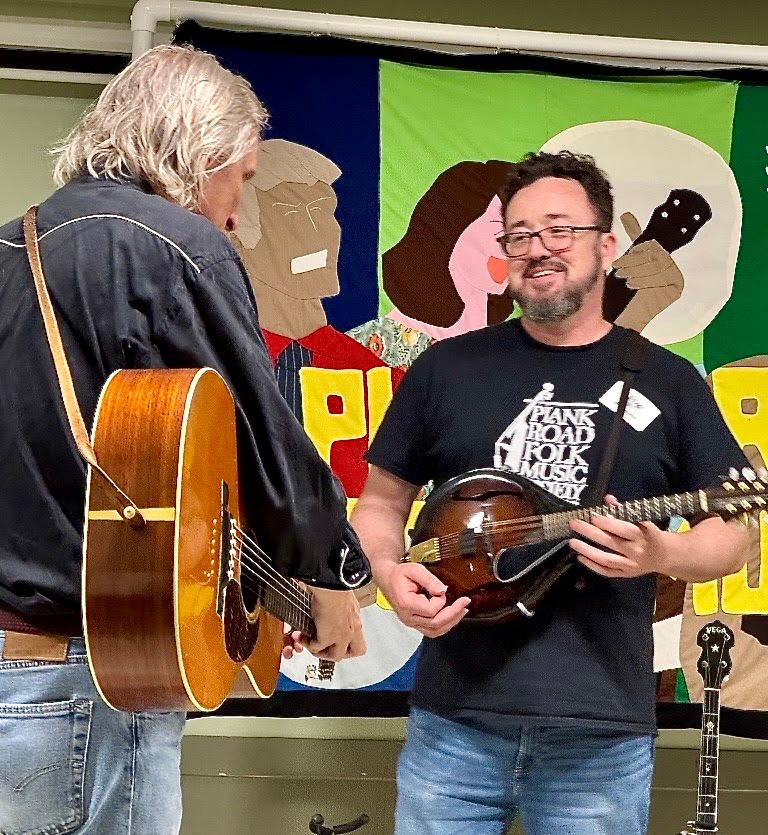
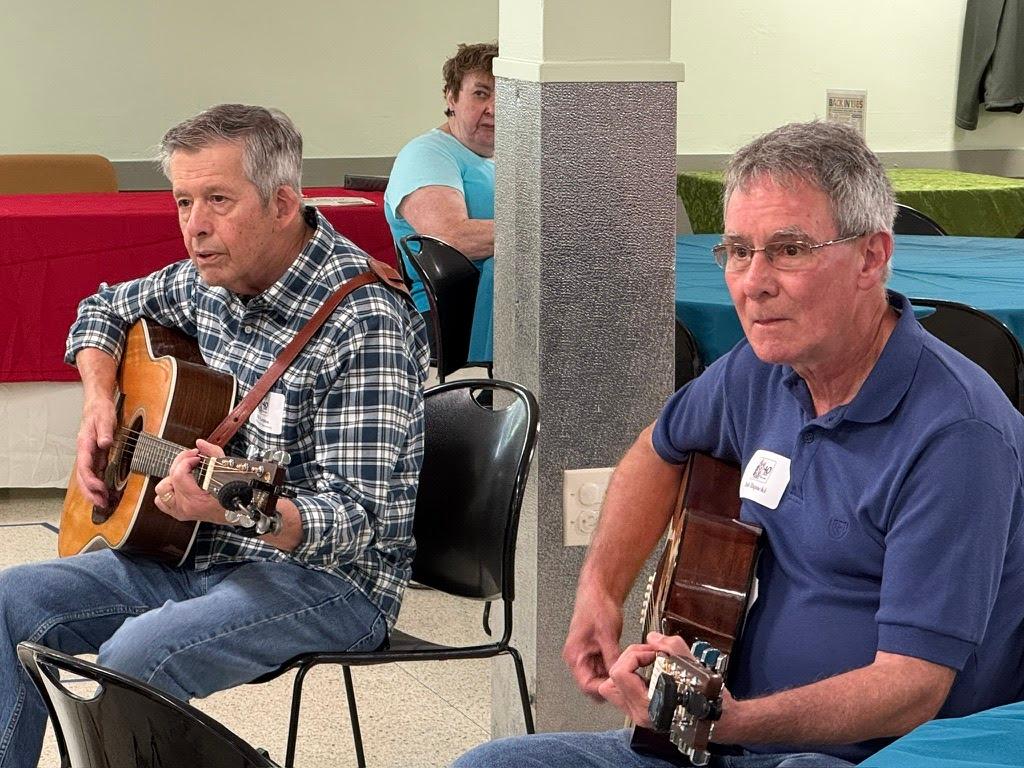
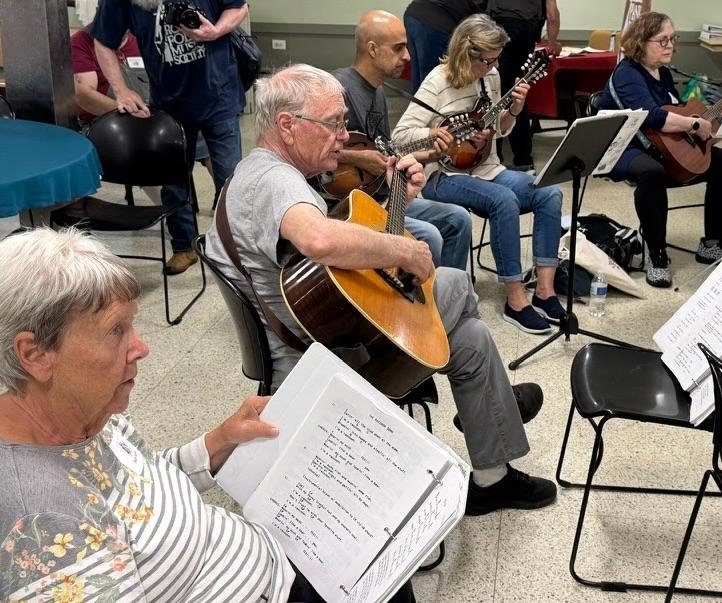
The
afternoon began at 2 PM
with folk and country
sing-arounds led by
George Mattson and Bob
O’Hanlon, plus lively
old-time music with
Betsy Anderson leading
the string band. As
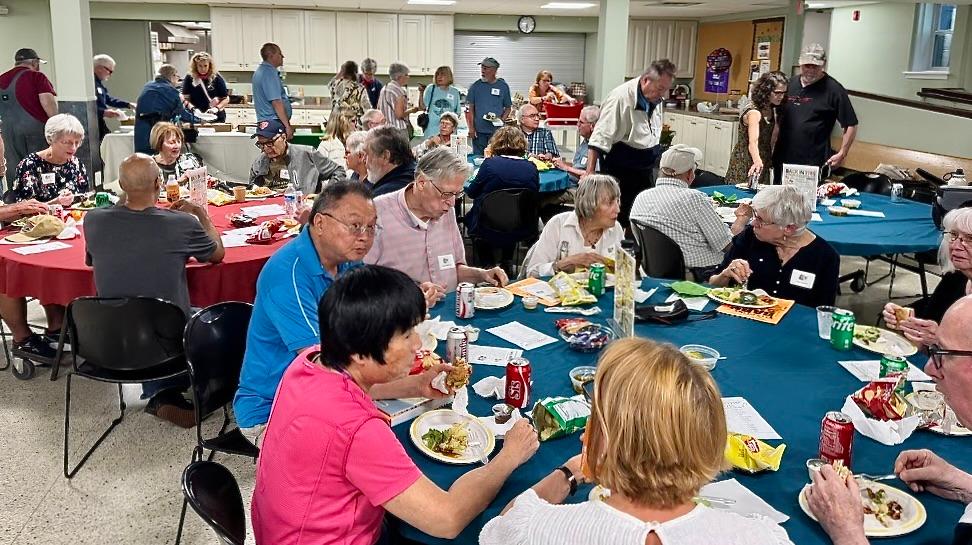
evening approached, we
were treated to snacks,
sandwiches, salads and
beverages — plus some
amazing desserts — and a
chance to socialize with
old and new
friends.
|
|
|
A
little history, and some
recognitions . .
.
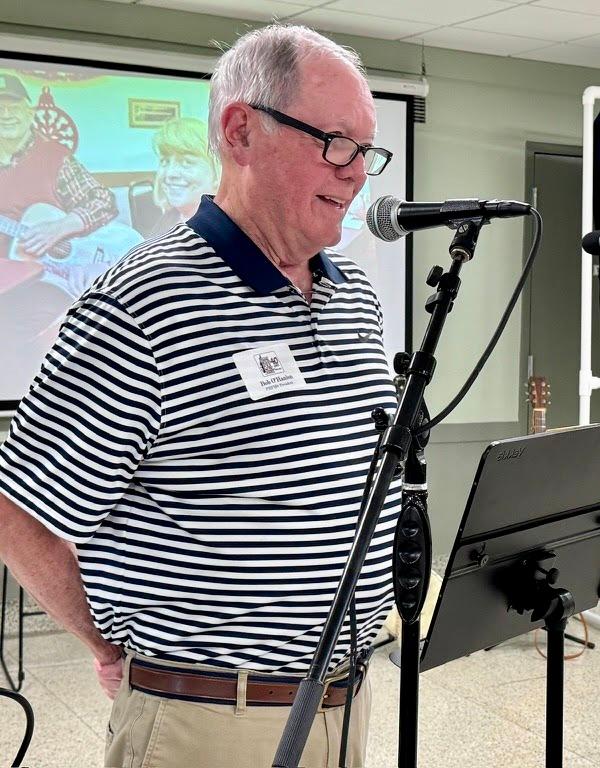
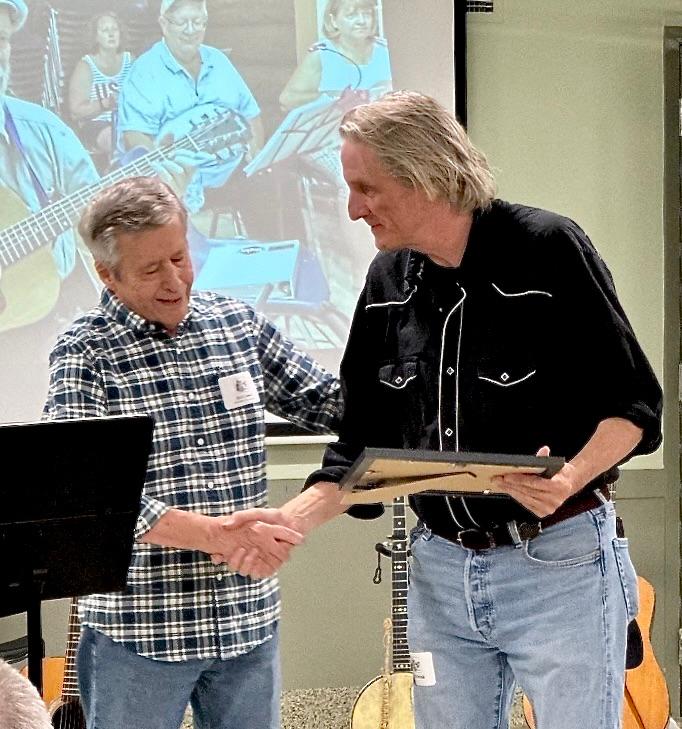
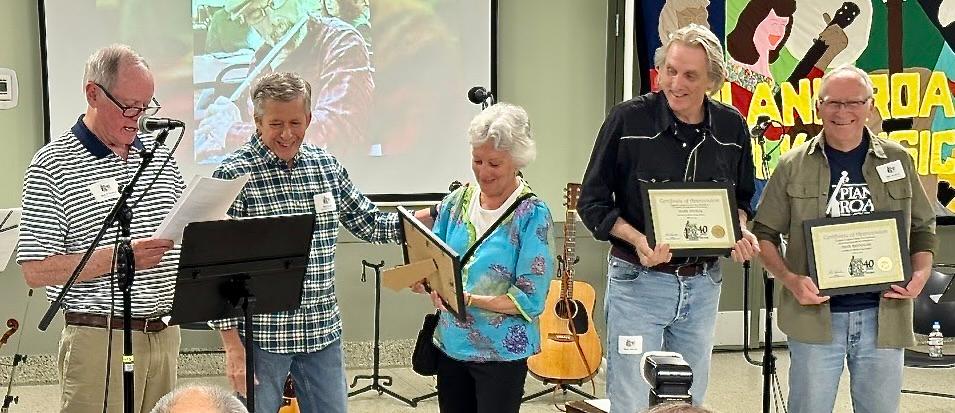
After
a brief break, Bob
O'Hanlon reviewed the
history of the Plank
Road Folk Music Society,
followed by tributes and
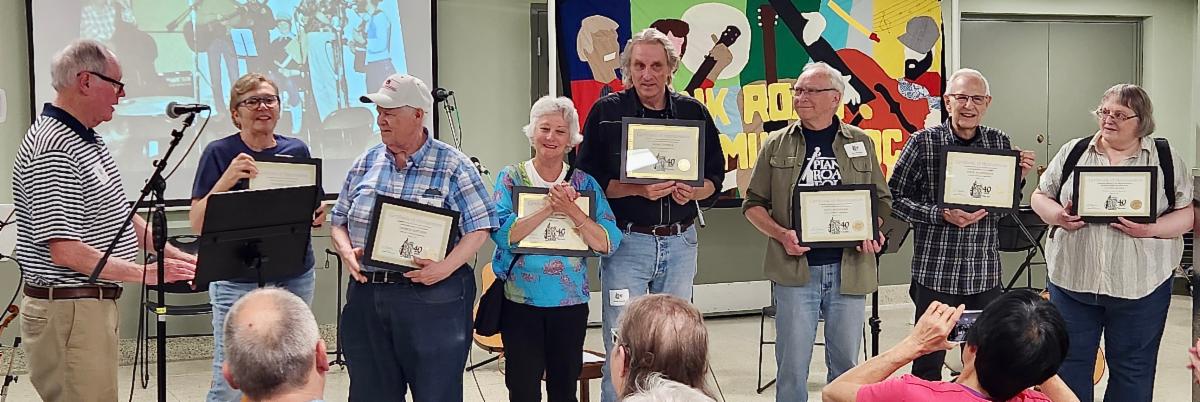
a presentation of framed
Certificates of
Appreciation to the
original founders, past
presidents and key
members.
He
said “If there was ever
a Hall of Fame for the
key members of Plank
Road, these are the
people who would be in
it.”
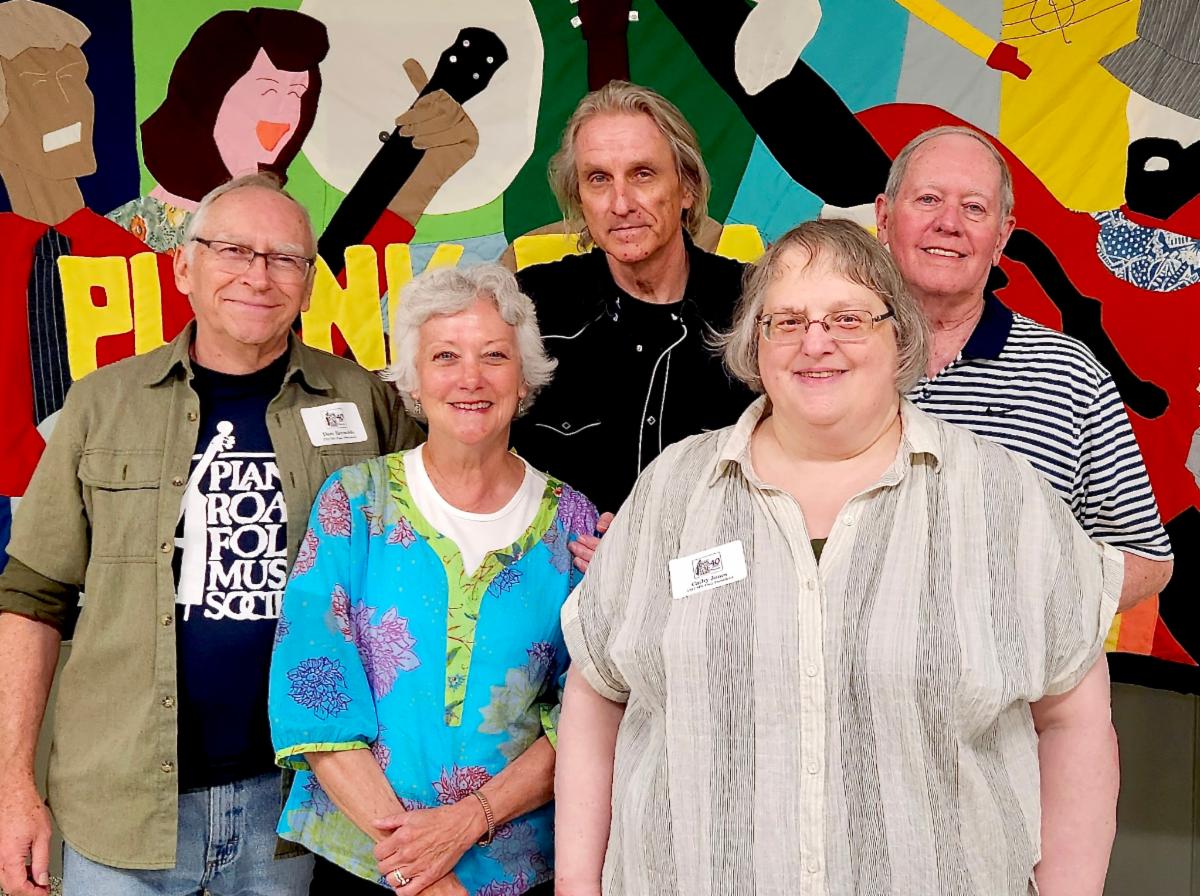
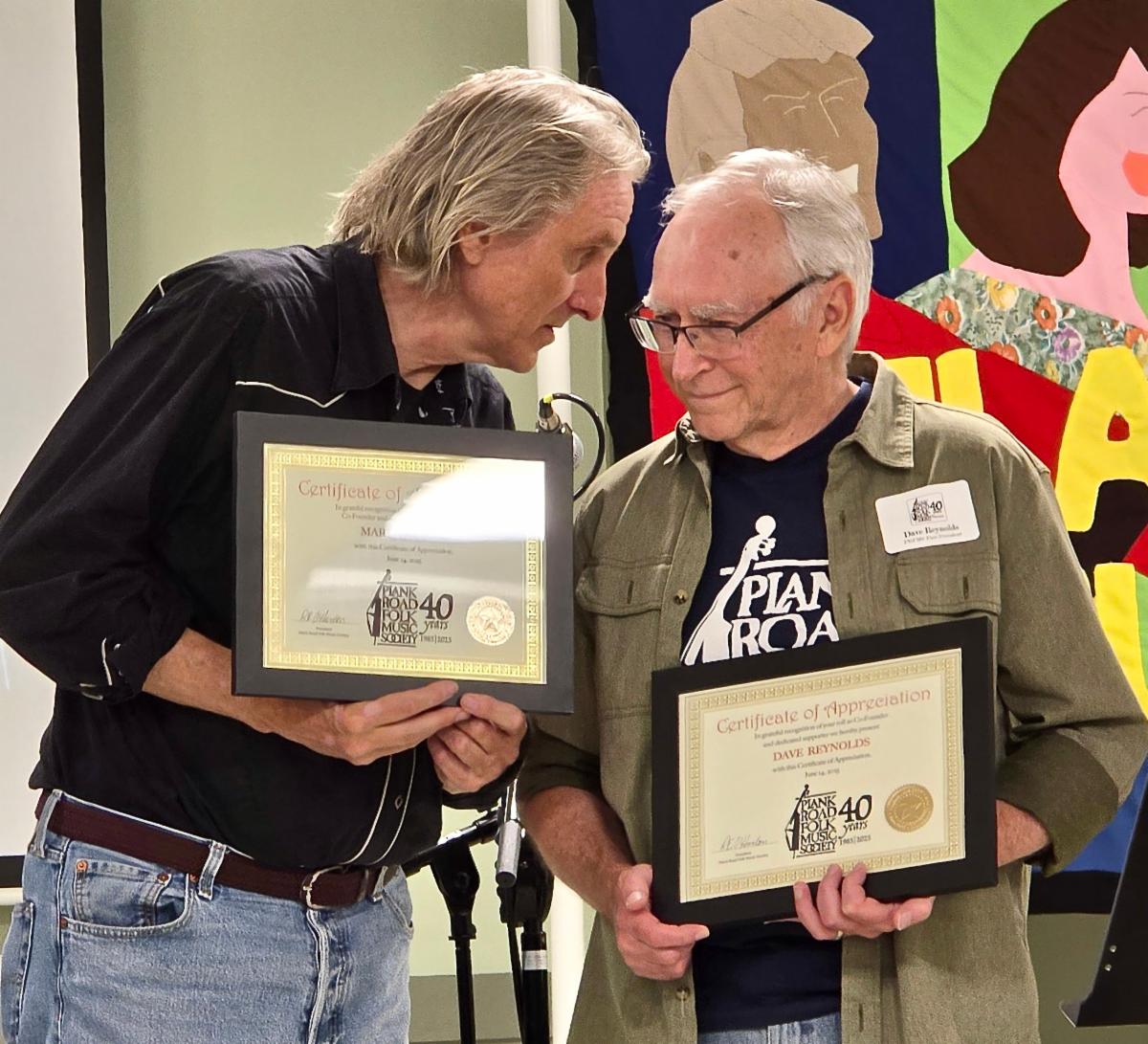
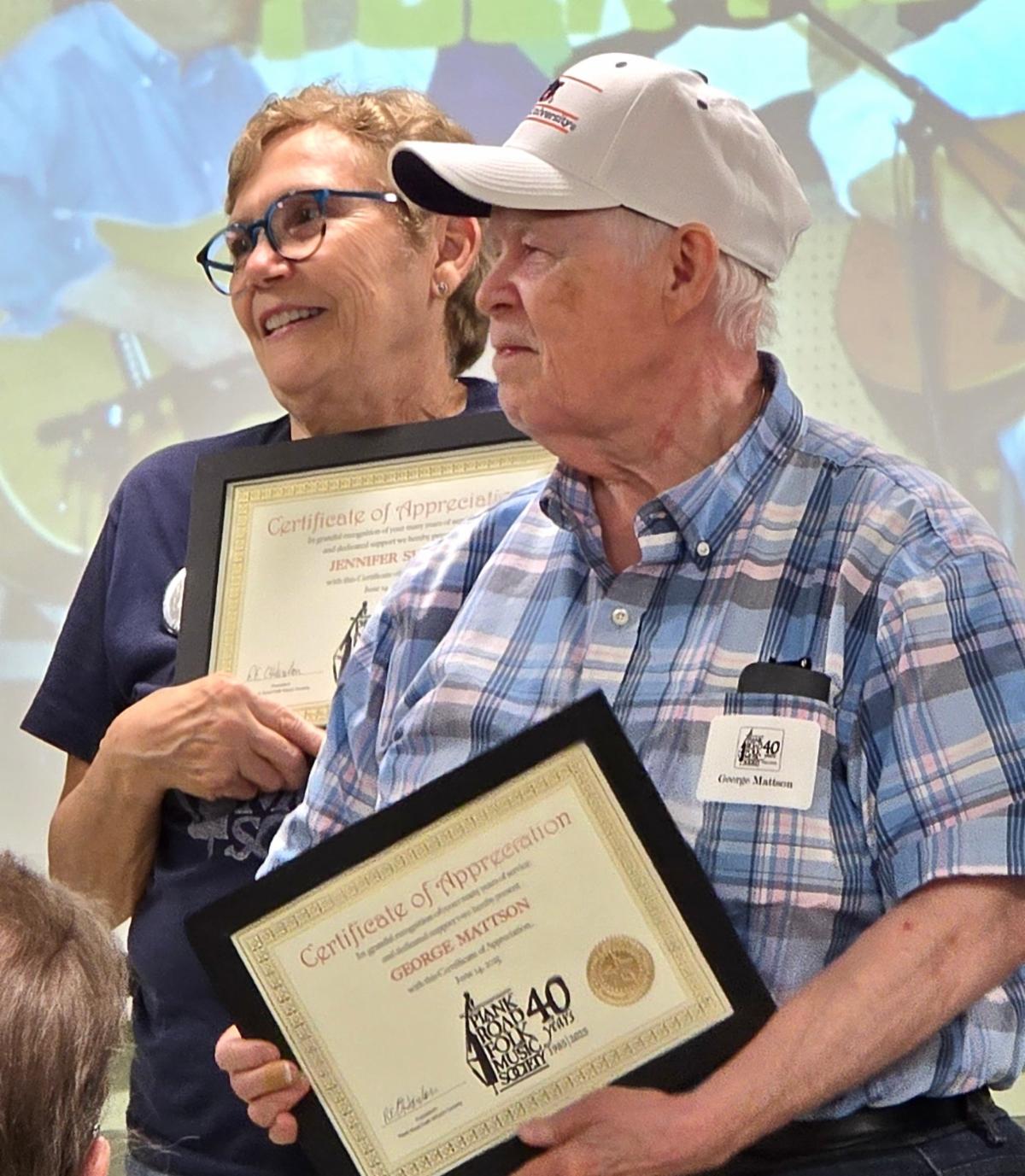
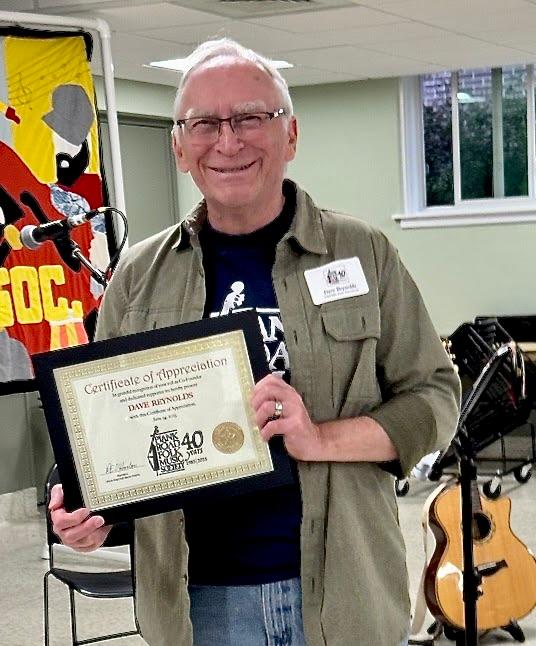
He
then presented
Certificates of
Recognition to two
original founders,
Dave
Reynolds (who
traveled all the way
from Florida) and
Mark
Dvorak. Also Marianne Mohrhusen,
who served many years as
President; Cathy
Jones,
who also served as
President, and has
contributed much over
the
years; Dave
Humphreys an
early board member from
the beginning, who
continues to serve on
the board
today; George
Mattson,
our fearless sing-around
leader for many years;
and Jen
Shilt,
long-time board member
who volunteers for
everything, including
graphic designer for our
promotional materials
and earlier
newsletters.
|
|
|
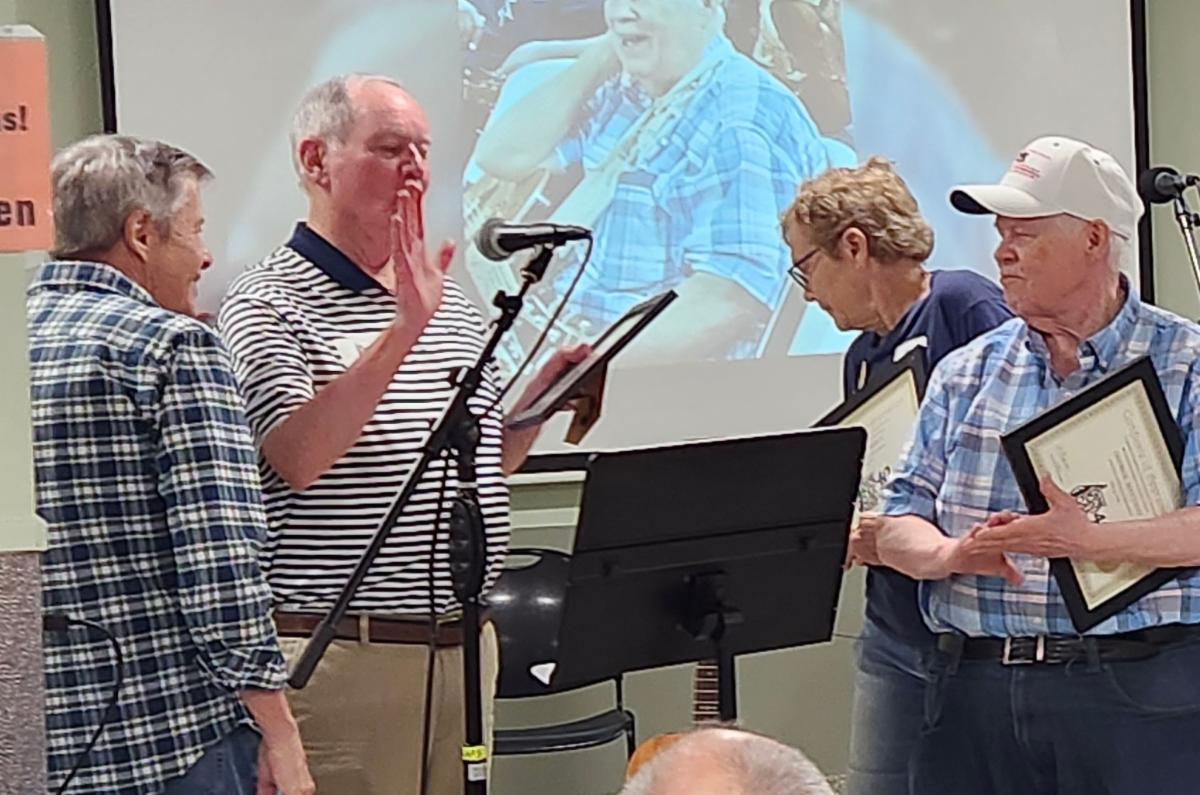
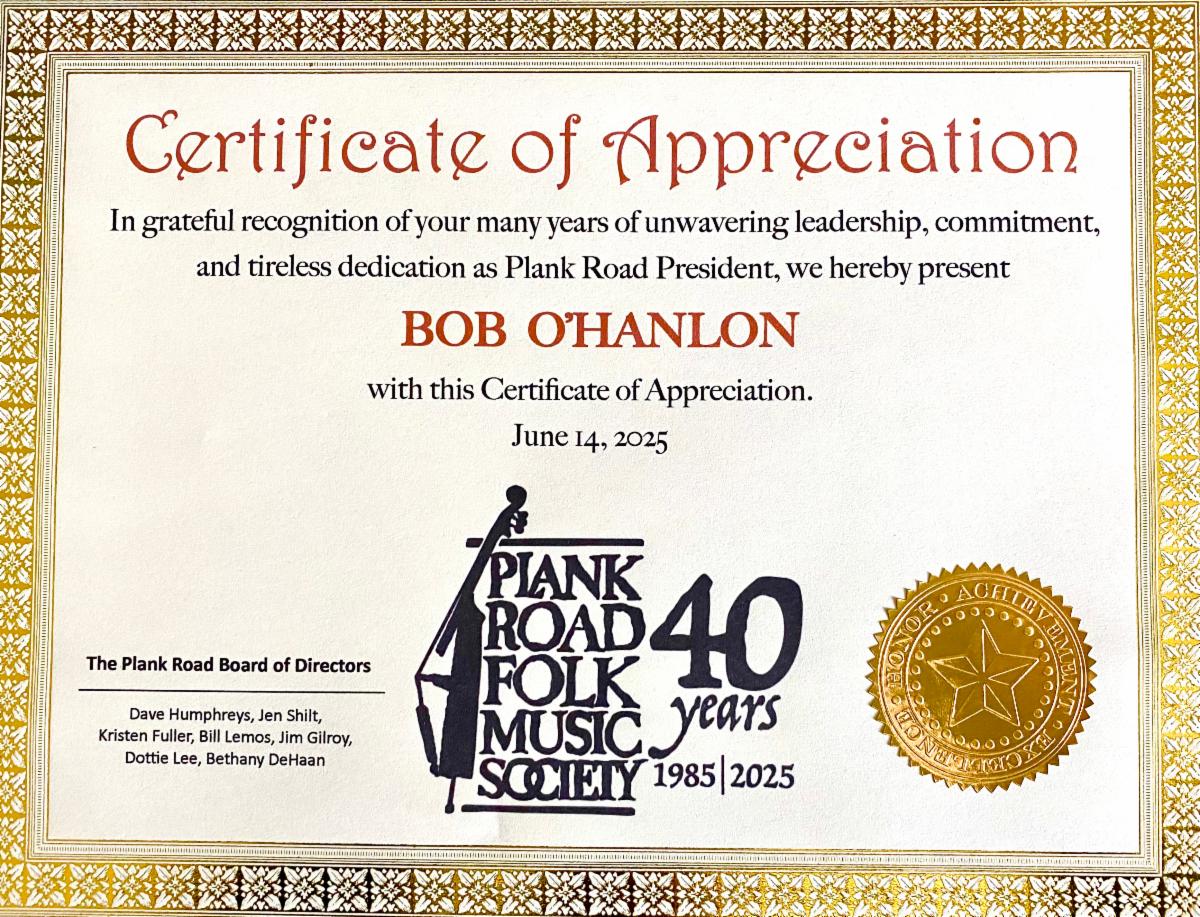
And
there was one more: As
Bob
O'Hanlon was
wrapping up, Bill Lemos
presented him with a
certificate, recognizing
his dedication and
service, including being
our longest-serving
president
— 18
years and
counting!
|
|
|
|
|
And
of course, more music .
. .
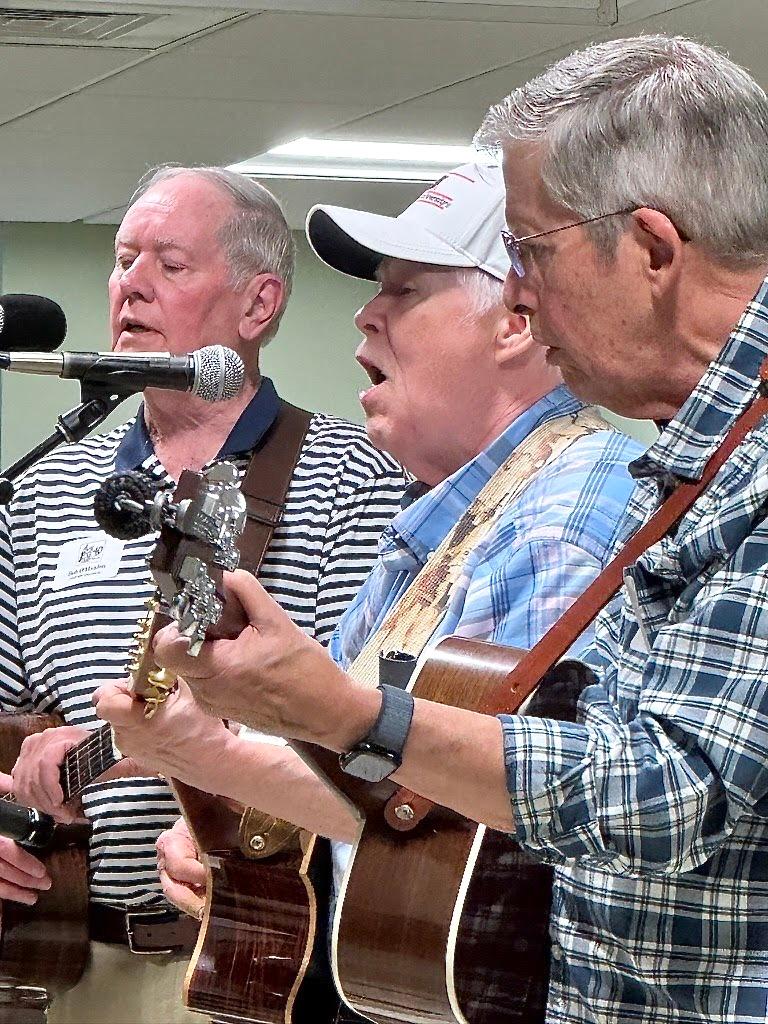
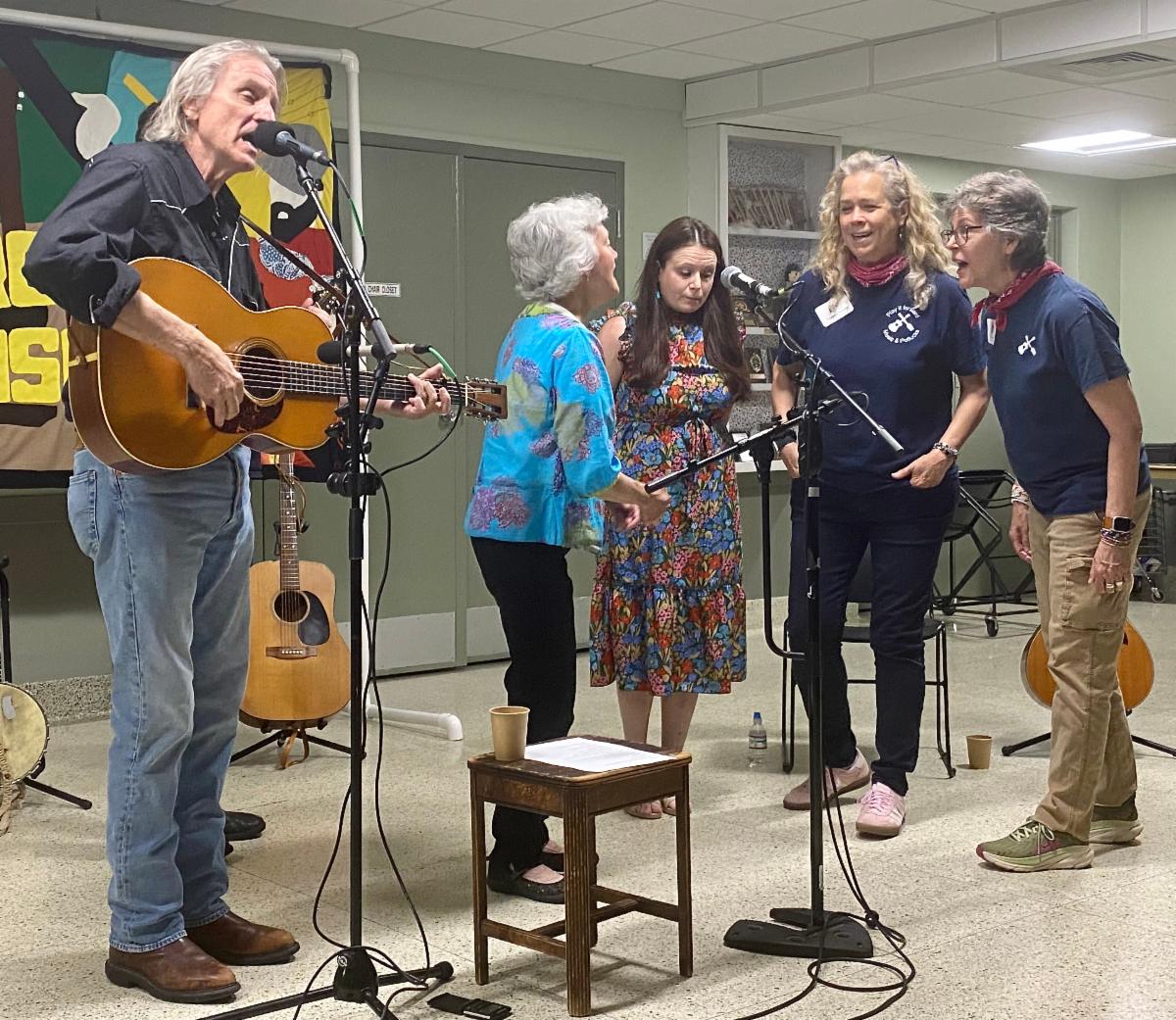
The
“warm-up act” featured
one song representing
each of Plank Road’s
most popular activities
— our Saturday folk and
country/western
sing-arounds, monthly
BYOS song circles, and
string band
sessions.
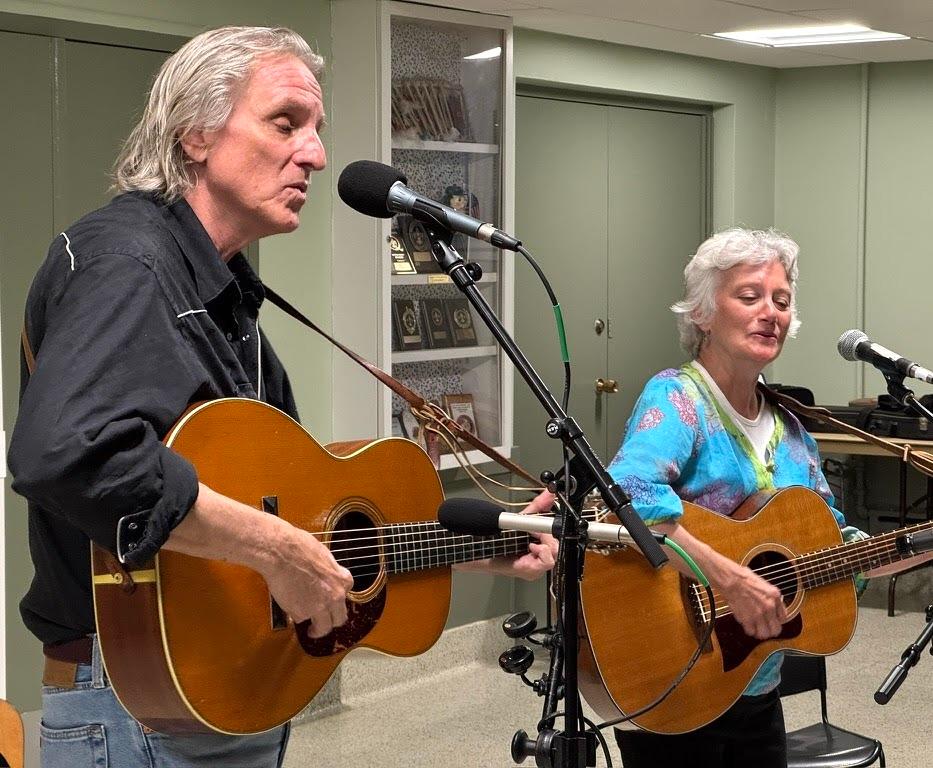
And
finally, the
long-awaited concert by
Mark
Dvorak
and Marianne Mohrhusen,
ending with everyone in
the room singing
along.
|
|
|
|
|
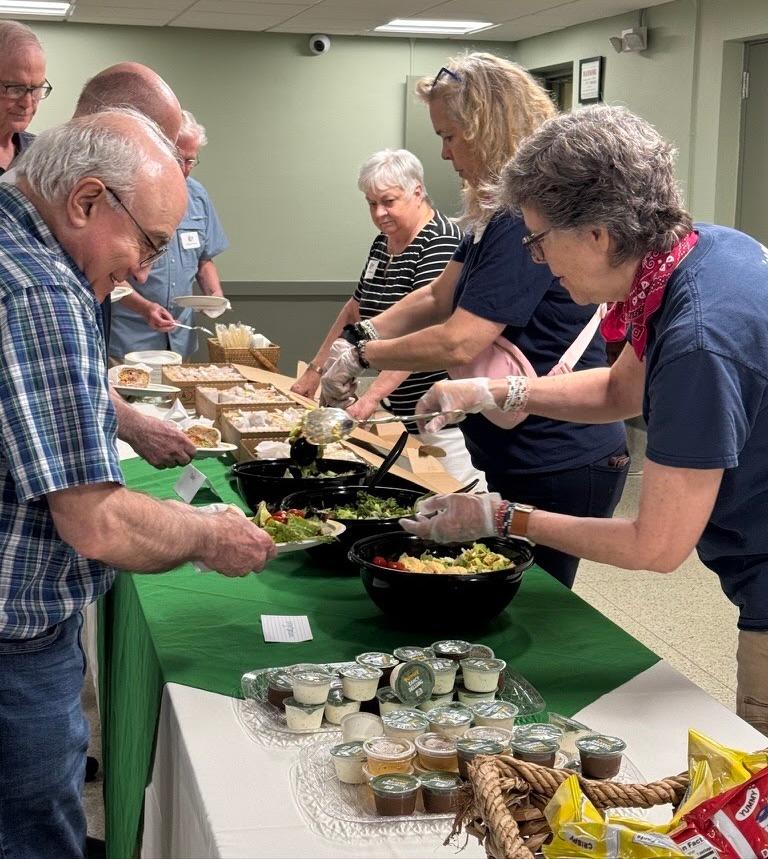
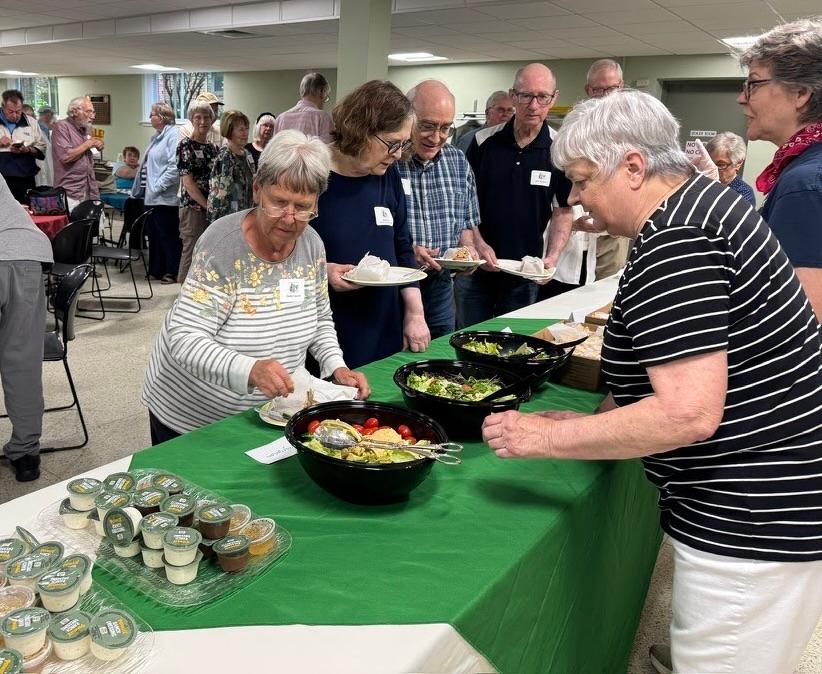
Meal
time!
Coordinated by Mimi O'Hanlon
and Bethany DeHaan, with
help from two volunteers
from Music & Potlucks.
|
|
|
Special
thanks to . . .
· Bob
O’Hanlon for
his many hours on the
planning committee,
keeping the team on
track, researching the
founding and long
history of Plank Road,
and his presentation,
followed by awarding
framed recognition
certificates to key
members.
· Bethany
DeHaan and Mimi
O’Hanlon for
managing all the food,
beverage and snack
arrangements. And
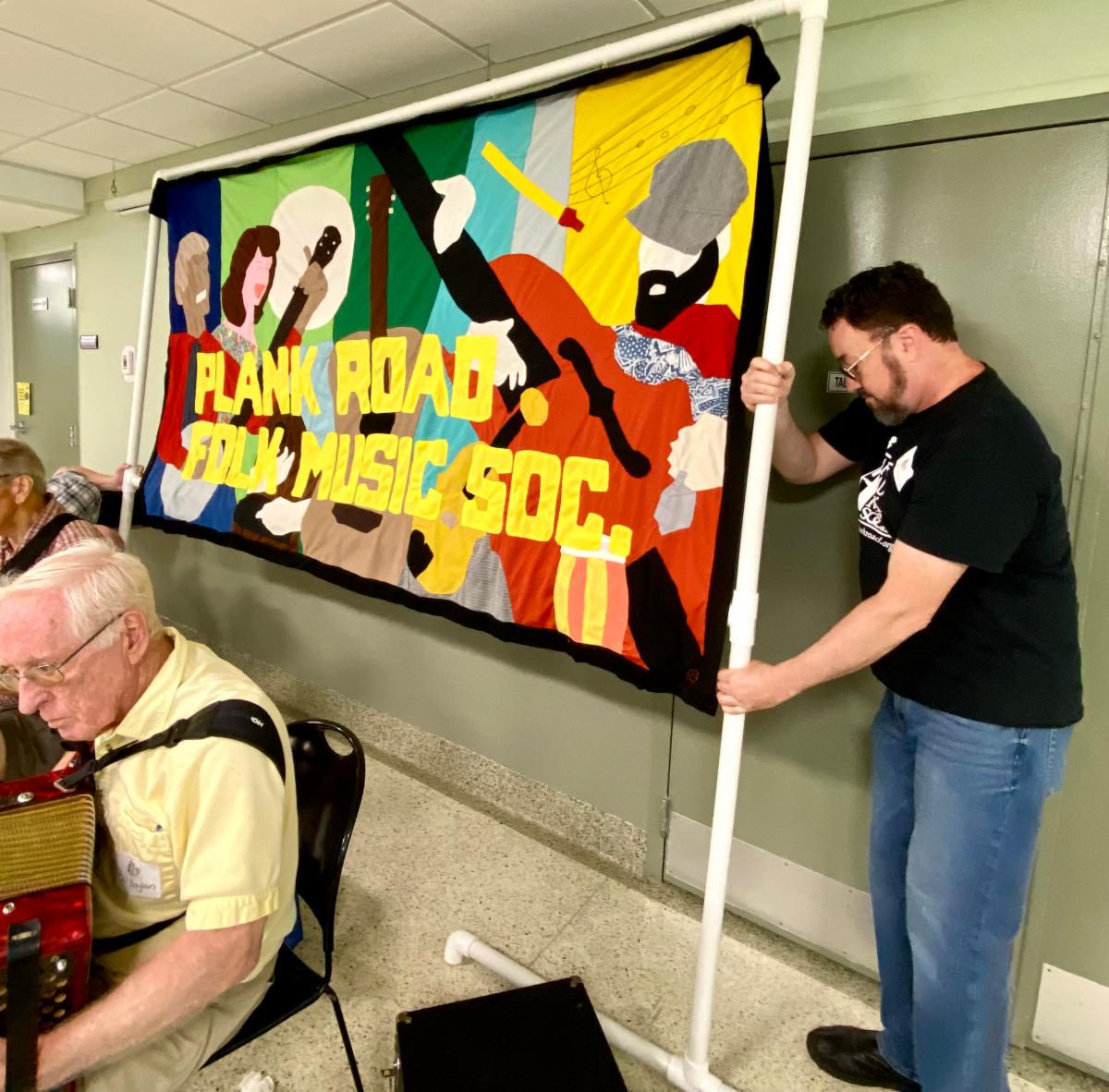
Bethany for the classy
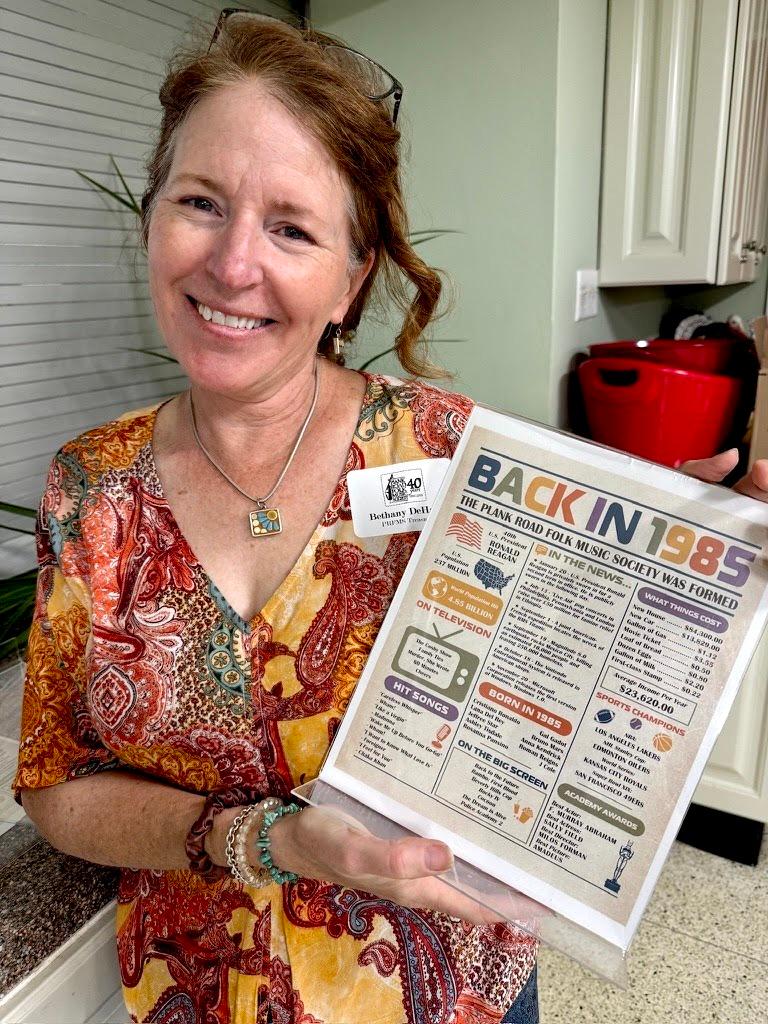
decor, 1985 signs and
trivia, and the custom
structure to display the
colorful quilt,
hand-made years ago by
Jeanne Halama.
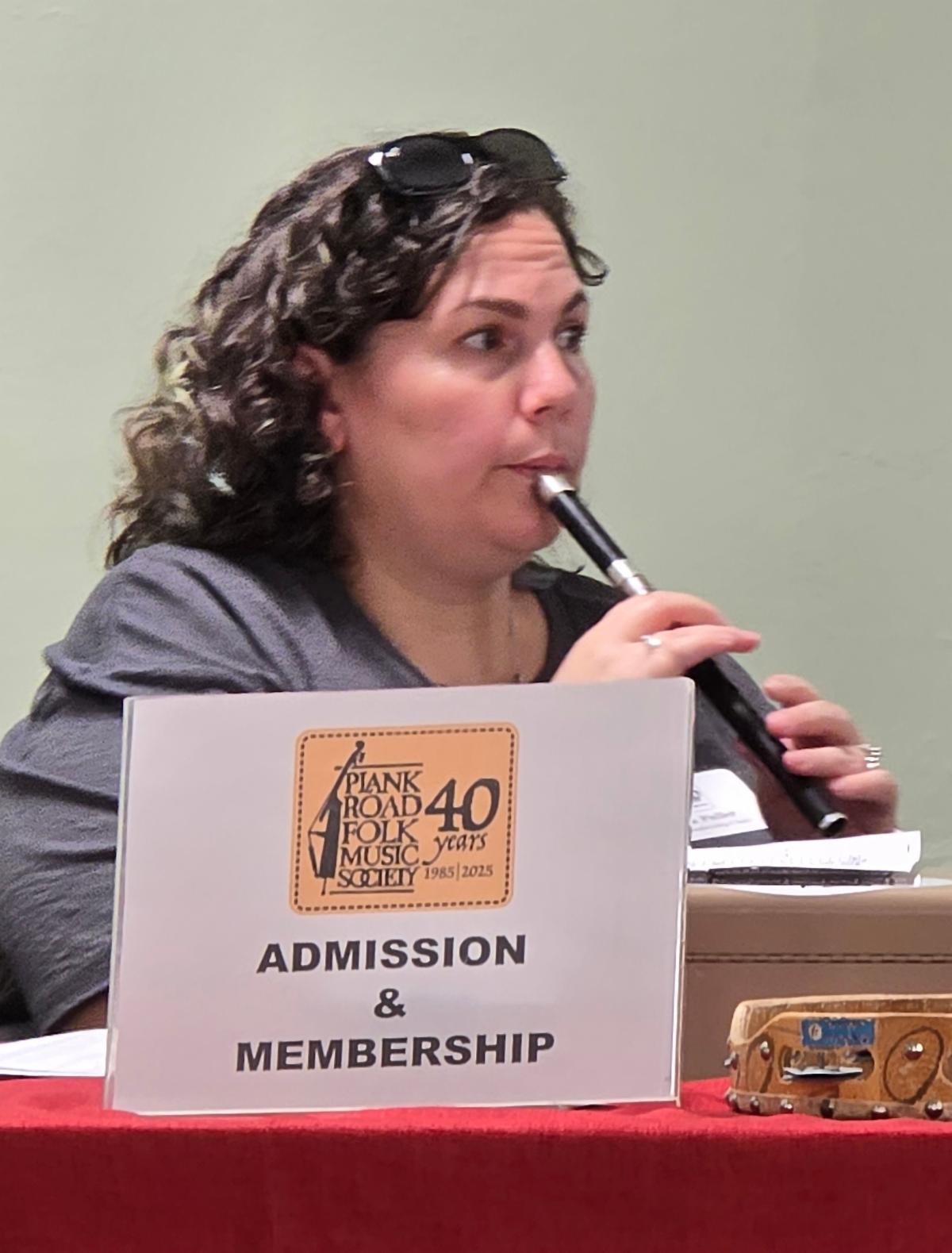
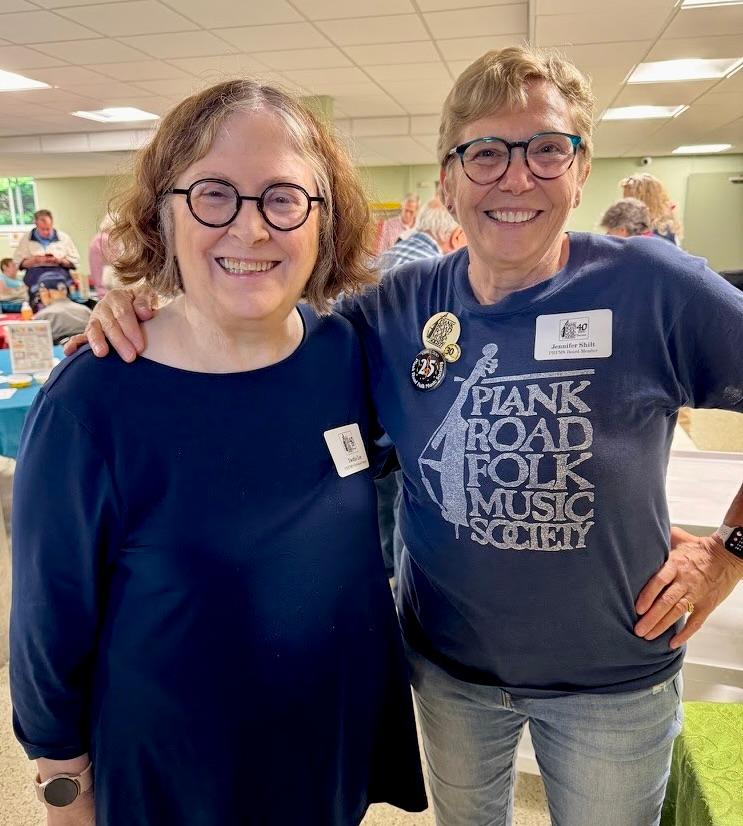
· Kristen
Fuller and Jen
Shilt for
a lot of
behind-the-scenes
planning and
communications with
Music & Potlucks.
Plus Jen for designing a
great 40th logo,
printing name tags,
signs and more — and
Kristen for manning the
ticket table all day and
night, but still able to
play the whistle during
the string band
segment.
· Bill
Lemos for
creating an email
promotional campaign,
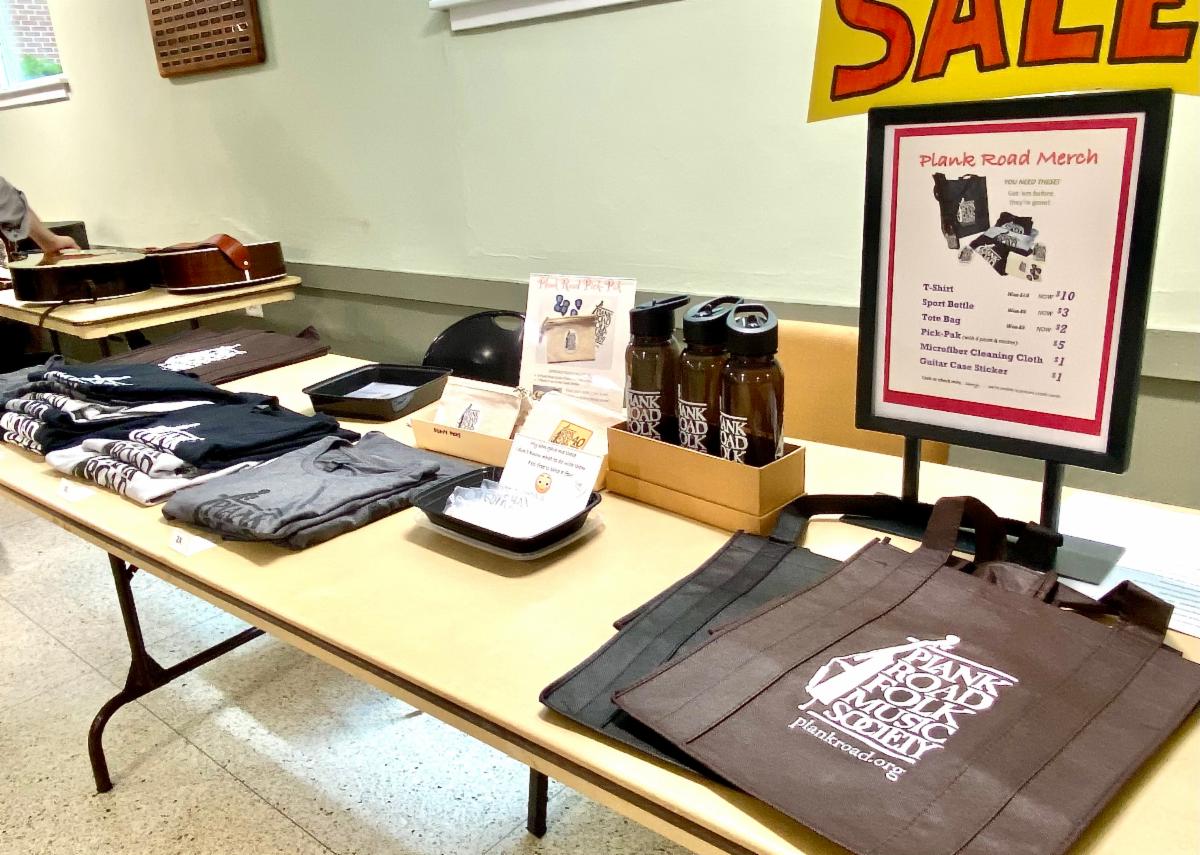
coordinating merchandise
and “party favors,” and
creating the honorary
certificates.
· Dottie
Lee for
her technical expertise
(and welcome advice) on
our email blitz, and
reminders on our website
and Facebook
page.
· George
Mattson, Betsy Anderson,
Cathy Jones, Bethany,
Bill and Bob for their
enthusiasm and rehearsal
time for the "warmup"
act.
· Dave
Humphreys for
his generous support and
booking the venue with
the church.
· Joel
Simpson for
setting up and manning
the sound equipment and
slide show, and ongoing
support of Plank
Road.
Plank
Road also
thanks Mark
Dvorak and Marianne Mohrhusen for
a great concert,
and Music
&
Potlucks,
the charitable
organization which
helped with ticket
sales, and provided two
wonderful volunteers to
help with the food
setup, distribution, and
cleanup. We also
appreciate and thank the
members (and spouses)
who helped with setting
up and tearing down the
chairs, tables,
decorations, signs —and
general cleanup.
Thanks
also for the
many
photographs, courtesy of
Jen Shilt, Kristen
Fuller, Dottie Lee, Bill
Lemos and Connie
Lemos.
And
speaking of photos —
here are a bunch
more!
|
|
|
In
1958,
the
Kingston
Trio’s
recording
of “Tom
Dooley”
sailed
to the
top of
the
charts.
Allan
Shaw,
then a
college
freshman,
loved
the band
so much
that he
taught
himself
to play
guitar
and
formed a
copycat
group
called
the
Highlanders.
The
Kingston
Trio
went on
to earn
13 Gold
Records.
Shaw
went on
to
become a
corporate
attorney.
He
loved
the
popular
folk
music of
the late
1950s
and
early
60s,
commonly
called
“the
folk
era” —
or
sometimes,
derisively,
“the
great
American
folk
scare.” In
1976 he
met the
Kingston
Trio,
becoming
friends
with
founding
member
Bob
Shane.
Soon
Shaw
began a
mail-order
business,
featuring
a small
catalog,
called
Kingston
Korner,
where
album-seeking
fans
could
find
special
order
Kingston
Trio
albums.
Word
spread
and soon
people
were
demanding
other
folk
artists
like the
Limeliters,
Bob
Gibson, the
Chad
Mitchell
Trio
and the
Brothers
Four.
In
1983 he
left the
corporate
world
and
started
a
private
legal
practice
in
downtown
Naperville.
But by
1985 his
lifelong
love of
music
became
his
business
as he
introduced
Folk Era
Records
and the
Rediscover
Music
Catalogue. Shaw
sought
out
wholesalers
that
would
sell to
him
directly,
and the
business
grew.
His
first
catalog
featured
only 8
or 10
albums,
but
eventually
expanded
to 80
pages.
Through
his Folk
Era
label he
began
reissuing
out-of-print
albums
by the
Kingston
Trio and
many
other
artists.
In 1986
Folk
Era was
the
first
label to
issue
folk
music on
CD.
Eventually
there
were more
than 70
reissues
and
previously
unreleased
albums
on his
label.
Allan
Shaw
died
January
29 at
age
84.
|
|
Allan
Shaw
(center)
and
Plank
Road’s
Gregg
Morton
(right)
play
their
respective
parts
during a
Friday
night
hootenanny
at Folk
Era
Records
in
Naperville.
Above
photo
and
portions
of
article
are from
a 2006
issue of
Naperville
Magazine,
by Dawn
Klingensmith.
|
|
Two
Way
Street
Coffee
House —
Friday
Night
Concert
Series.
Doors
open at
7:30pm
and
concerts
start at
8pm. You
can also
view
concerts
online —
more
information
on Two
Way
Street
Coffee
House or Facebook.
Maple
Street
Concerts.
Enjoy
live
concerts
at Maple
Street
Chapel
in
downtown
Lombard.
Please
check
the Maple
Street website for
concert
listings.
Other
venues .
.
.
-
Acoustic
Renaissance
Concerts
-
Old Town
School
Of Folk
Music
-
Tobias
Music
Concerts
|
|
5th
Saturday
Workshop
features
Chris
Walz and
bluegrass
guitar
|
|
On
May 31
the
second
5th
Saturday
Workshop
of the
year was
held at
Two Way
Street
Coffee
House
with
bluegrass
multi-instrumentalist
Chris
Walz.
Widely
known
for his
lightning
speed on
banjo,
guitar
and
mandolin,
the
2-part
workshop
focused
on
Bluegrass
Rhythm
Guitar,
followed
by
Bluegrass
Lead
Playing.
"It's
all
about
the
rhythm
and
tempo,"
said
Chris,
as he
covered
correct
pick
grip,
runs,
rhythm
licks
and
more.
|
|
The second
workshop
focused on
lead
techniques,
building
into a solid
foundation
for single
note
playing.
More
Workshops
to
come!
The
workshops
are held at
Two Way
Street
Coffee
House, in
partnership
with Plank
Road, under
the
direction
of Joel
Simpson
and
Jennifer
Ashley.
|
|
Put
these
future
workshops
on your
calendar!
Check
Two Way
Street
and
Plank
Road
websites
and
Facebook
pages
for more
information.
-
August
30
- Vocal
Workshop
with
Bobcat
Opossum
-
November
29
- Ukulele
Workshop
with
Lil
Rev
|
|
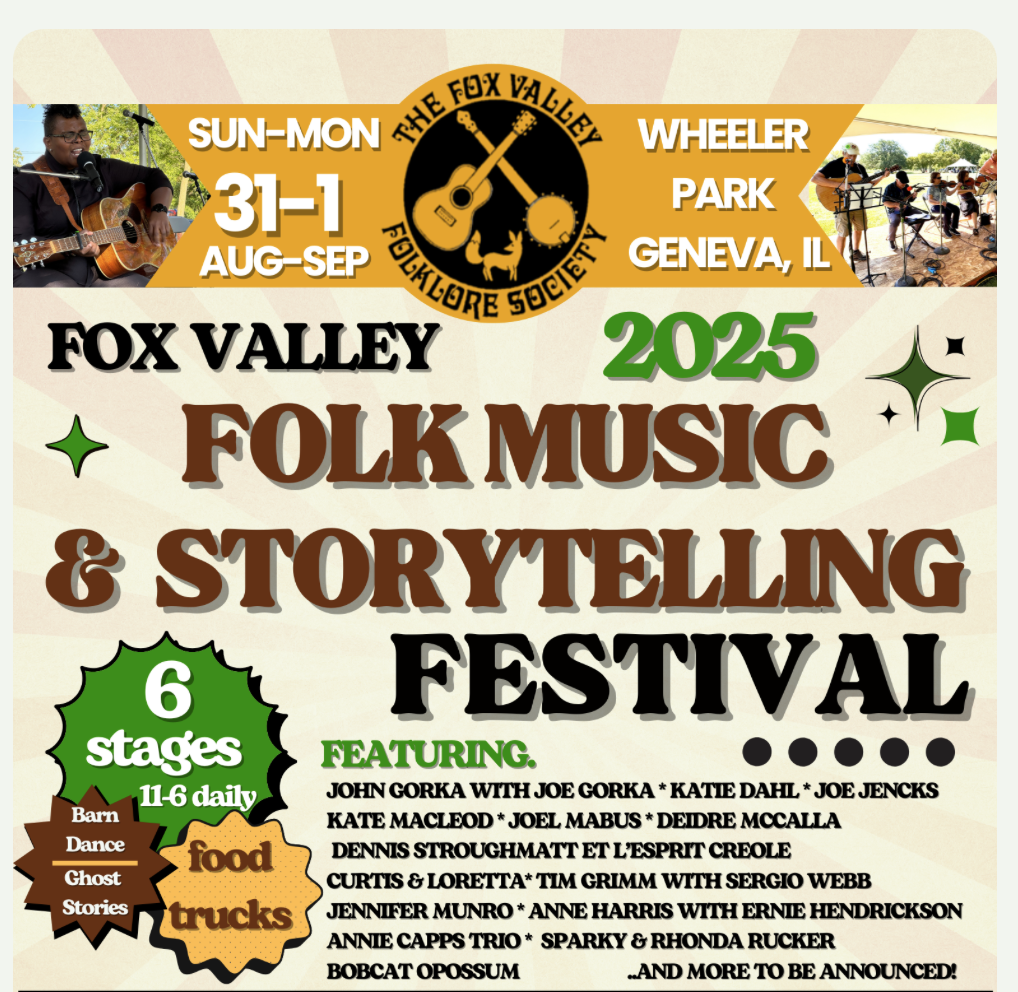
SAVE
THE
DATE!
Fox
Valley
Folk
Festival
Labor
Day
Weekend
Aug.
31 &
Sep.
1
Enjoy
the last
summer
holiday
weekend
listening
to live
music
and
storytelling!
Fox
Valley
Folk
Music
Festival
will
again be
in
beautiful
Wheeler
Park,
Geneva.
- Six
stages
with
dozens
of
featured
artists!
- Continuous
concerts,
workshops,
arts
&
crafts
—
and
great
music!
- Spontaneous
jamming
—
bring
your
instrument!
- Multiple
food
trucks!
The
festival
is an
all-volunteer
run
event!
Please
consider
becoming
a member
of our
team.
For
information,
go to
FVFS.org
|
|
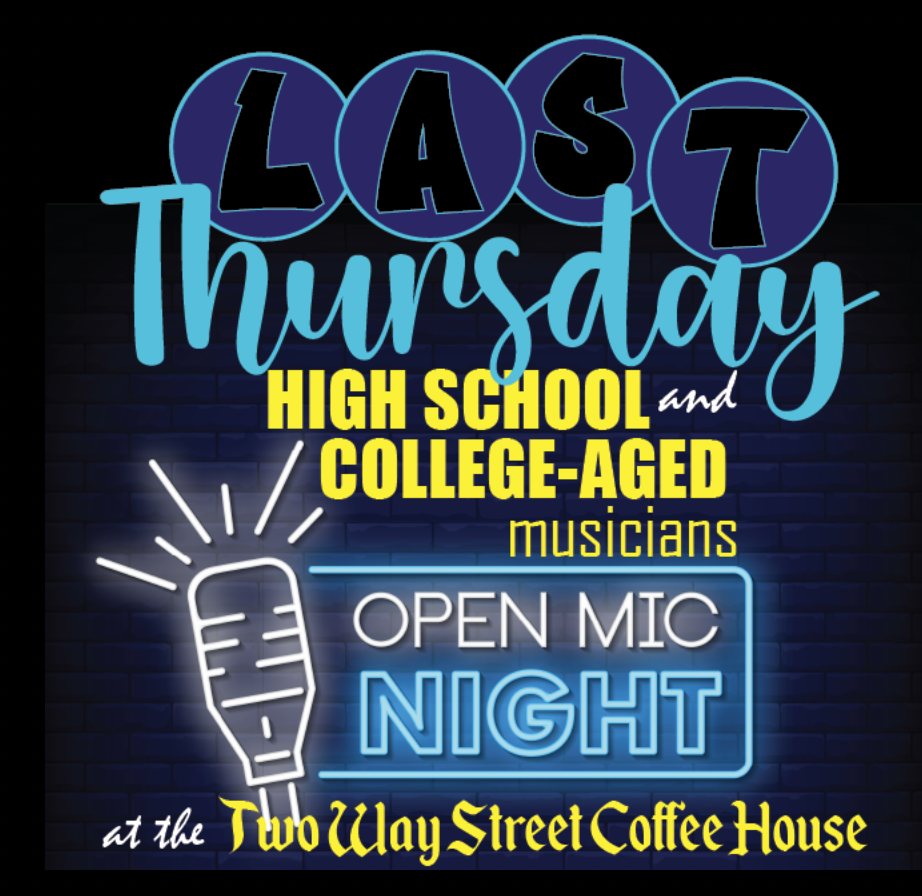
“Last
Thursday”
returns
to Two
Way
Street
Coffee
House
Do
you know
a high
school
or
college-aged
musician
who’s
looking
for an
open
mic? Two
Way
Street
Coffee
House
has
brought
back
it’s
popular
“Last
Thursday”
open mic
night.
As
the name
implies,
it’s
held
every
last
Thursday
of the
month,
now
through
October,
from 7-9
PM. It’s
a great
opportunity
for
younger
folks to
“step
into the
spotlight”
on
stage,
with a
live
audience
— and a
livestream
too!
Perfect
for
acoustic
musicians,
poets
and
performance
artists.
Full AV
setup
and
helpful
volunteers
are
provided.
For
more
information,
check twowaystreet.org
|
|

|
|
The
Mississippi
Delta .
.
.
.
. . a
time of
struggle,
and the
development
a new
original
form of
American
music.
By
Wayne
Oestreicher
My
interest
in the
development
of
American
Blues
led me
to these
four
related
books
dealing
with the
history
of the
Mississippi
Delta —
each in
its own
way.
Each one
has been
an eye
opener
to me.
Sometimes,
I, like
many
people,
want to
forget
the past
and move
on. But
James
Baldwin
said,
“The
great
force of
history
comes
from the
fact
that we
carry it
within
us, are
unconsciously
controlled
by it in
many
ways and
history
is
literally
present
in all
that we
do.”
|
|
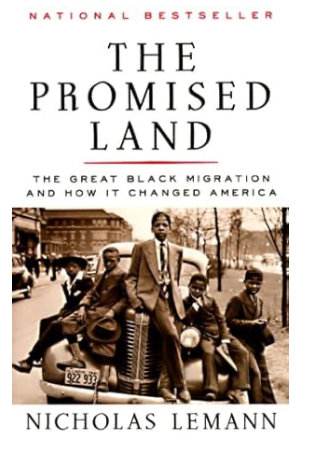
The
Promised
Land by
Nicholas
Lemann.
This
book
recounts
the
history
of the
Great
Black
Migration
and how
it
changed
America.
It
covers
the
period
from
1940 to
1970,
especially
the
migration
from the
Mississippi
Delta to
Chicago
as well
as other
northern
cities.
It deals
with the
response
by
northern
policy
makers
to this
phenomenon.
It
discusses
the
civil
rights
struggle
in the
south as
well as
the
civil
unrest
in the
north.
|
|
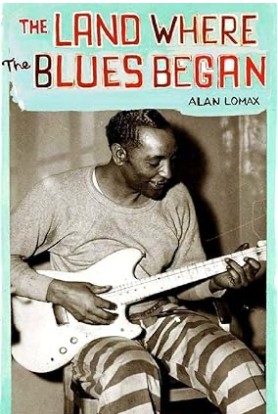
The
Land
Where
the
Blues
Began
by
Alan
Lomax.
While
telling
of his
experiences
of
making
field
recordings
of
blues,
gospel
and
other
forms of
music
indigenous
to the
Delta,
he tells
the
stories
of the
lives of
black
folks in
the
Mississippi
Delta
throughout
the 20th
century.
|
|
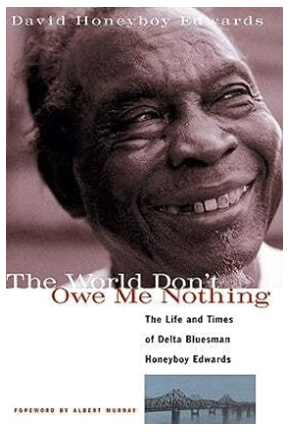
The
World
Don’t
Owe Me
Nothing
- The
Life and
Times of
Delta
Bluesman
Honeyboy
Edwards.
Recounts
the life
story of
Honeyboy
Edwards
growing
up in
the
Delta
and
living
the life
of a
traveling
blues
musician
during
the
1920’s,
30’s and
40’s.
His
stories make
the
reality
of the
brutally
racist
Delta
society
really
hit
home. He
ended up
in
Chicago
and died
in 2011
at age
96. He
lived in
relative
obscurity
till his
career
was
revived
at the
end of
his
life. I
have
seen
Honeyboy
perform
many
times
including
one special
performance
on the
main
stage of
the
Chicago
Blues
Fest
when his
90th
birthday
was
celebrated.
|
|
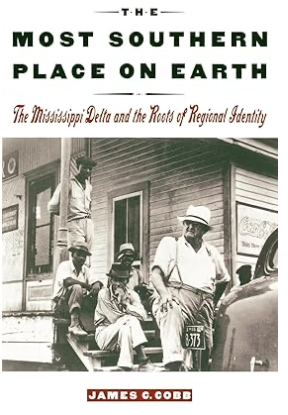
The
Most
Southern
Place on
Earth,
The
Mississippi
Delta
and the
Roots of
Regional
Identity by
James C.
Cobbs.
This
excellent
book
covers
the
history
of the
Mississippi
Delta
from
pre-Civil
War to
the
1990s.
If you
have an
interest
in the
history
of the
Mississippi
Delta
and the
development
of the
Blues,
this
might be
one for
you.
This scholarly
dense
book
thoroughly
examines
the
regional
history
of the
Delta.
|
|
Each
of these
books is
about
the
struggle
of
African
Americans
in the
Mississippi
Delta
from the
time of
slavery
through
the
great
migrations
in the
20th
century
up to
present
times.
It is a
heartbreaking
story
and in
the
middle
of this
story is
the
chronicle
of the
development
of a new
original
form of
music.
It is
the
Blues
created
by these
sharecroppers,
former
slaves
and
descendants
of
slaves.
A music
that has
gone on
to
arguably
influence
all
forms of
American
music
that
came
after
it.
I
hope
that
some of
you may
find
these
books as
interesting
and
helpful
as I
did.
-
Wayne
Oestreicher
|
|
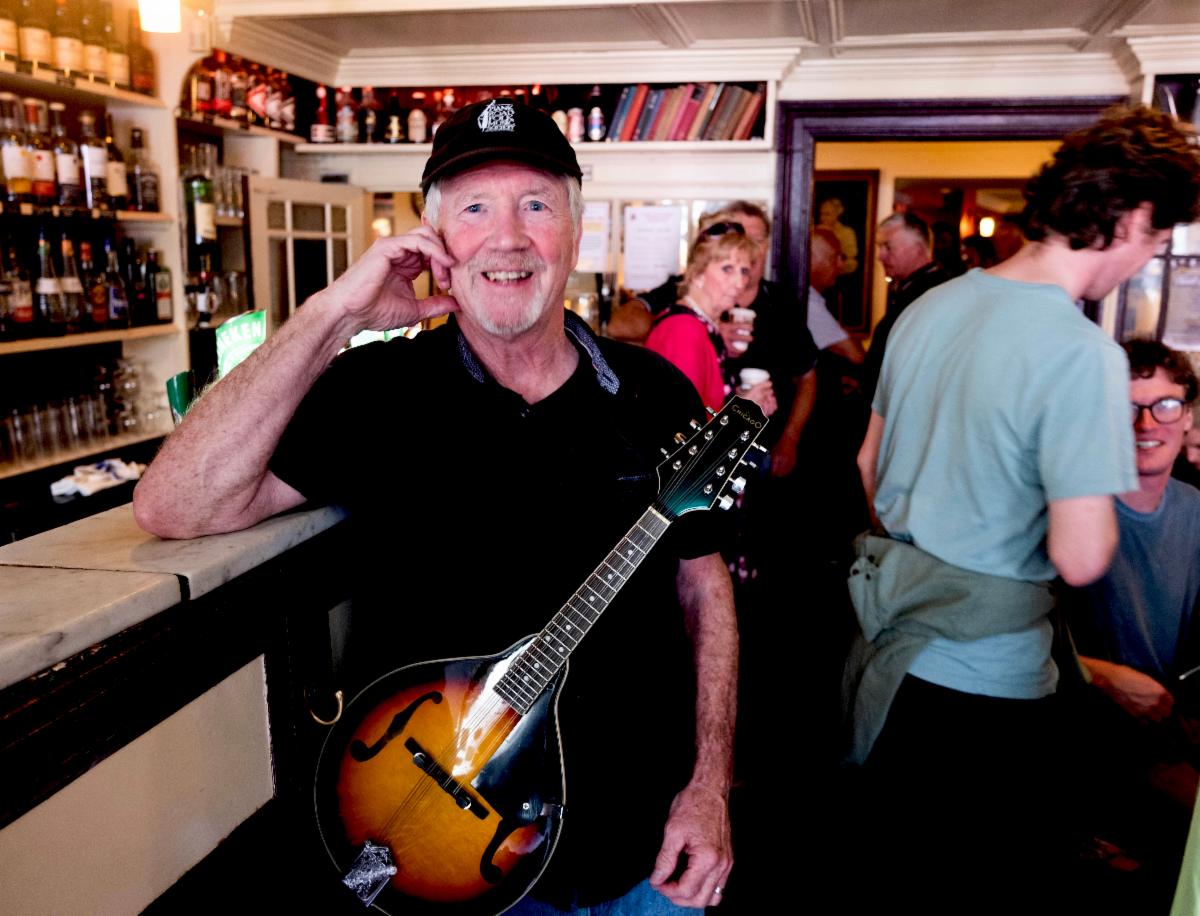
Summer
in
Ireland
with Jim
Gilroy
and his
mandolin.
|
|
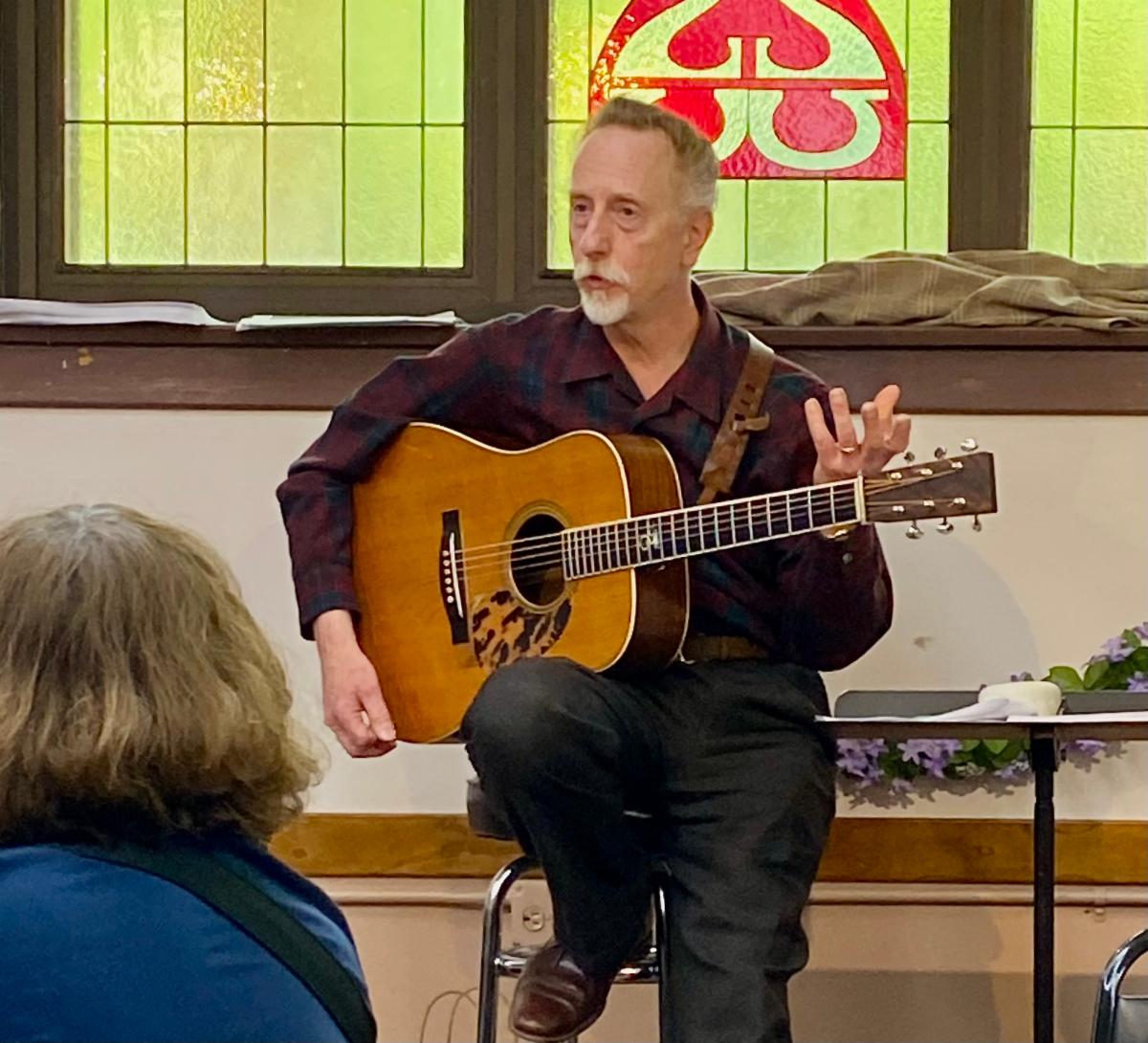
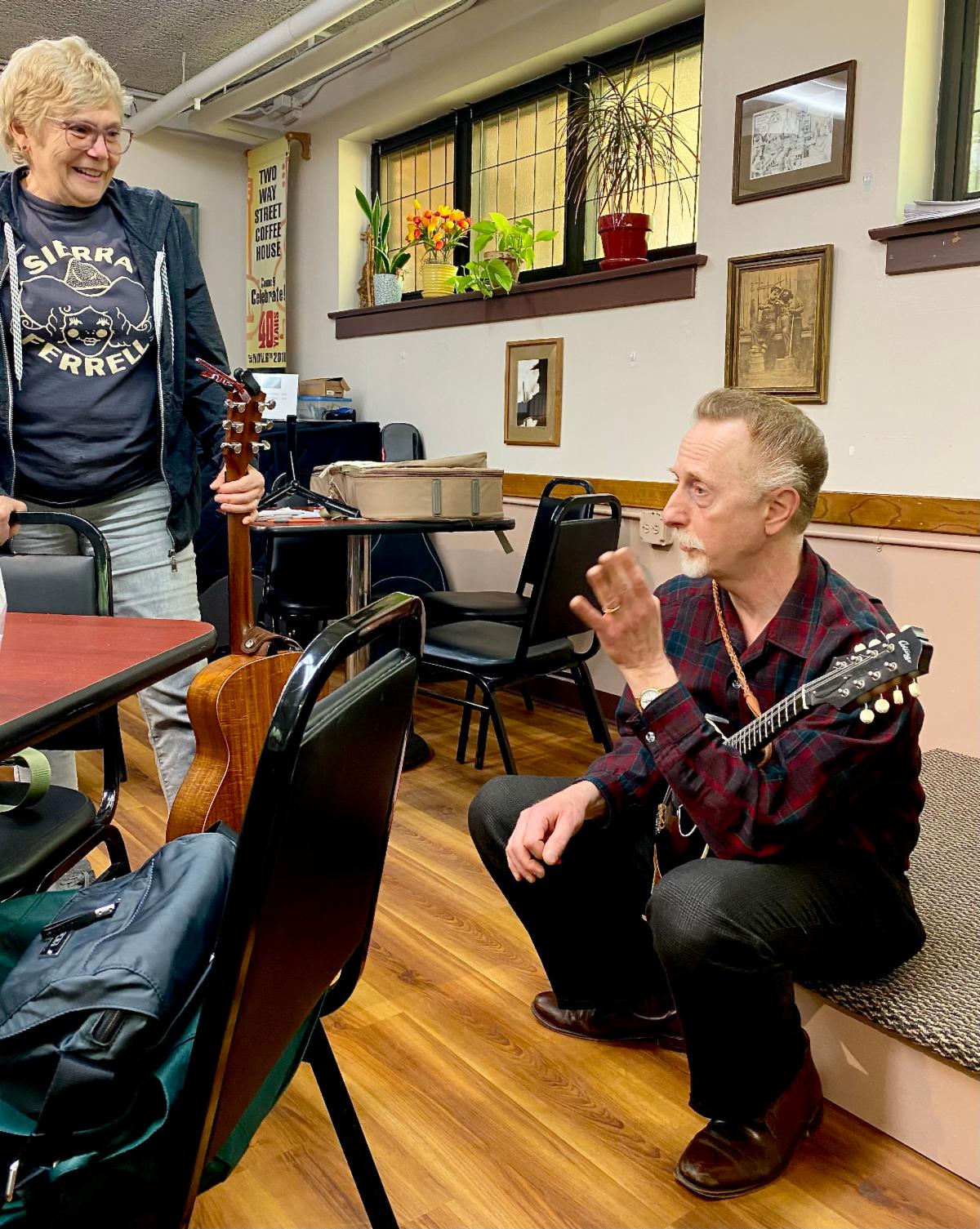
Jim
Gilroy
and wife
Jenneine
are
spending
the
summer
in
County
Clare,
Ireland
with
family
and
friends
— and
attending
music
festivals
and
informal
jams at
local
pubs. Oh
yes,
also
doing
lots of
maintenance
on the
family
property.
There’s
a
well-known
annual
festival
called “Scoil
Samhraidh
Willie
Clancy,” featuring
traditional
Irish
music,
dance,
lectures,
workshops,
recitals
and
concerts. “It’s
the
event of
the year
for the
area,”
says
Jim.
“Businesses
can make
enough
money to
sustain
a whole
year. 10
days of
crowds
from all
over the
world.”
|
|
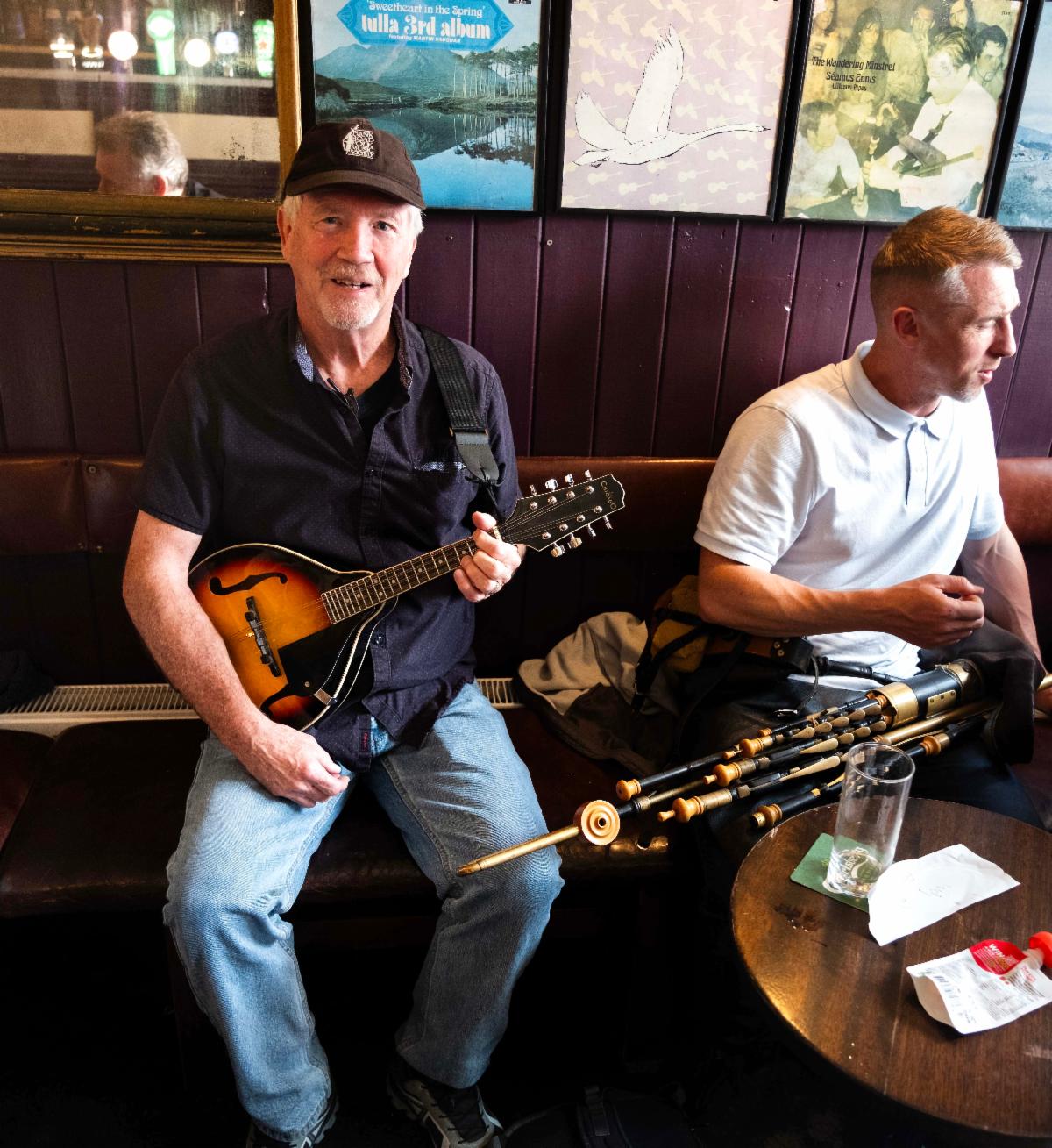
When
asked
about
playing
his
mandolin
at
events,
Jim said
the
mandolin
gets
drowned
out if
there
are too
many
fiddles
or
banjos,
and adds
“there
are
too many
banjos!”
|
|
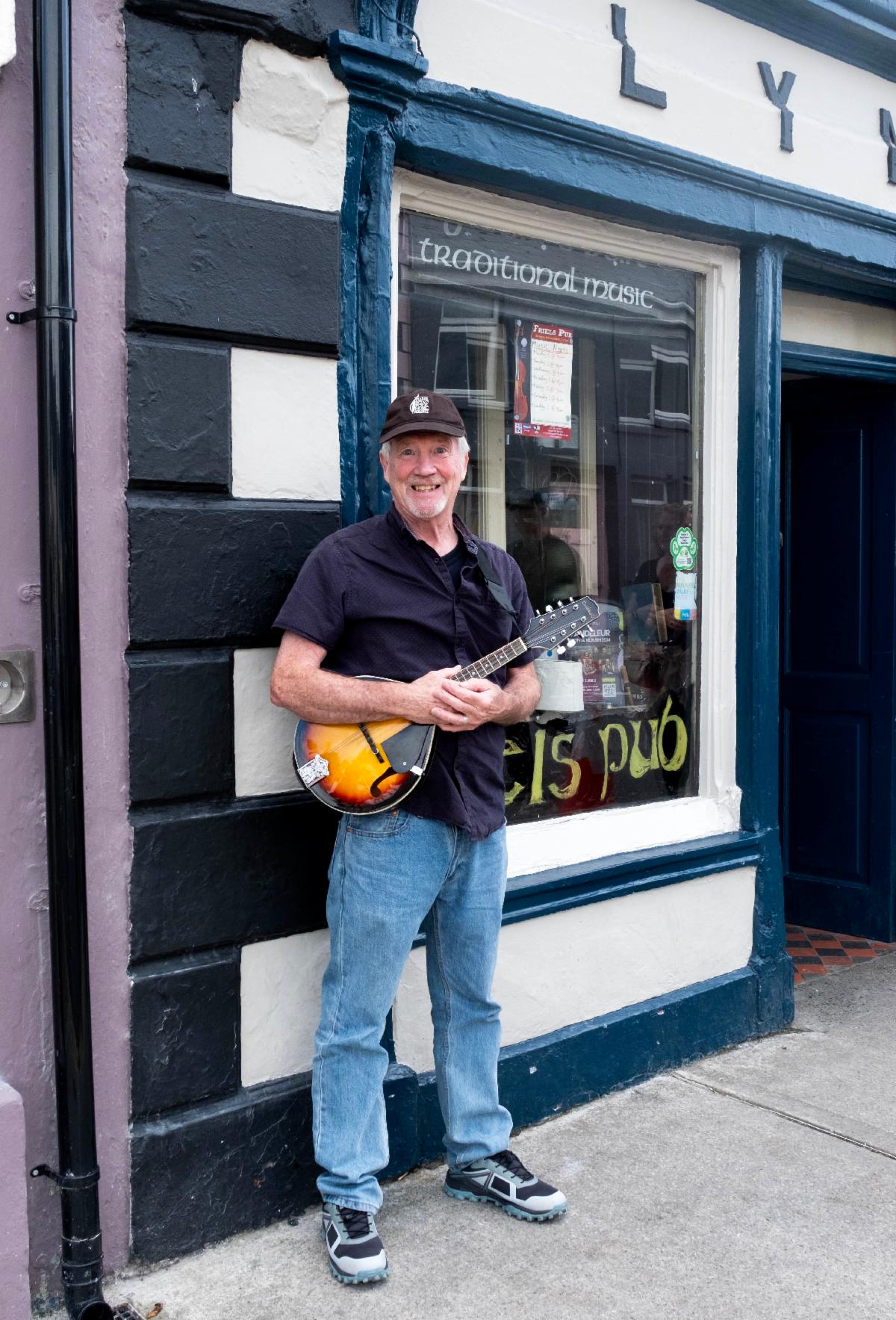
Jenneine
said
this
photo
was
taken in
front of
Friels
Pub,
where
many
well-known
musicians
stop by
for a
session.
“It’s a
gem of a
pub,”
says
Jenneine.
“It’s
sort of
our
‘local’
as they
say over
here.”
|
|
Jim
explains
“Set
Dancing”
and how
it
differs
from
square
dancing.
Set
Dancing
is also
a big
part of
the
festival. It’s
based
on quadrilles, danced
to Irish
tunes in
groups
of eight
or four
dancers.
These
were
transformed
by the
Irish
into a
unique
folk
dance of
the
Irish
rural
communities.
Many
sets are
named
after
specific
areas of
Ireland.
Sets
differ
from square
dance in
that
they do
not
require
a caller as
the
dancers
know the
set by
name.
Each
dance or
‘set’
consists
of three
to seven
(most
often
four or
five)
short
‘figures’
which
are
danced
in
sequence,
with a
pause
between
each two
figures.
The
dances
are
performed
to
different
types of
Irish
traditional
dance
tunes,
including
reels,
jigs,
hornpipes,
slides,
and
polkas. The
typical
speed
for
Irish
set
dancing
music
falls
within
the
range of
92 to
132
beats
per
minute
(BPM),
with the
"sweet
spot"
generally
considered
to be
between
100 and
116
BPM.
|
|
George
Mattson
Trio and
Lonesome
Eagle
take the
stage at
Two Way
Street.
Plank
Road was
well-represented
at
recent
Friday
night
concerts
at Two
Way
Street
Coffee
House.
|
|
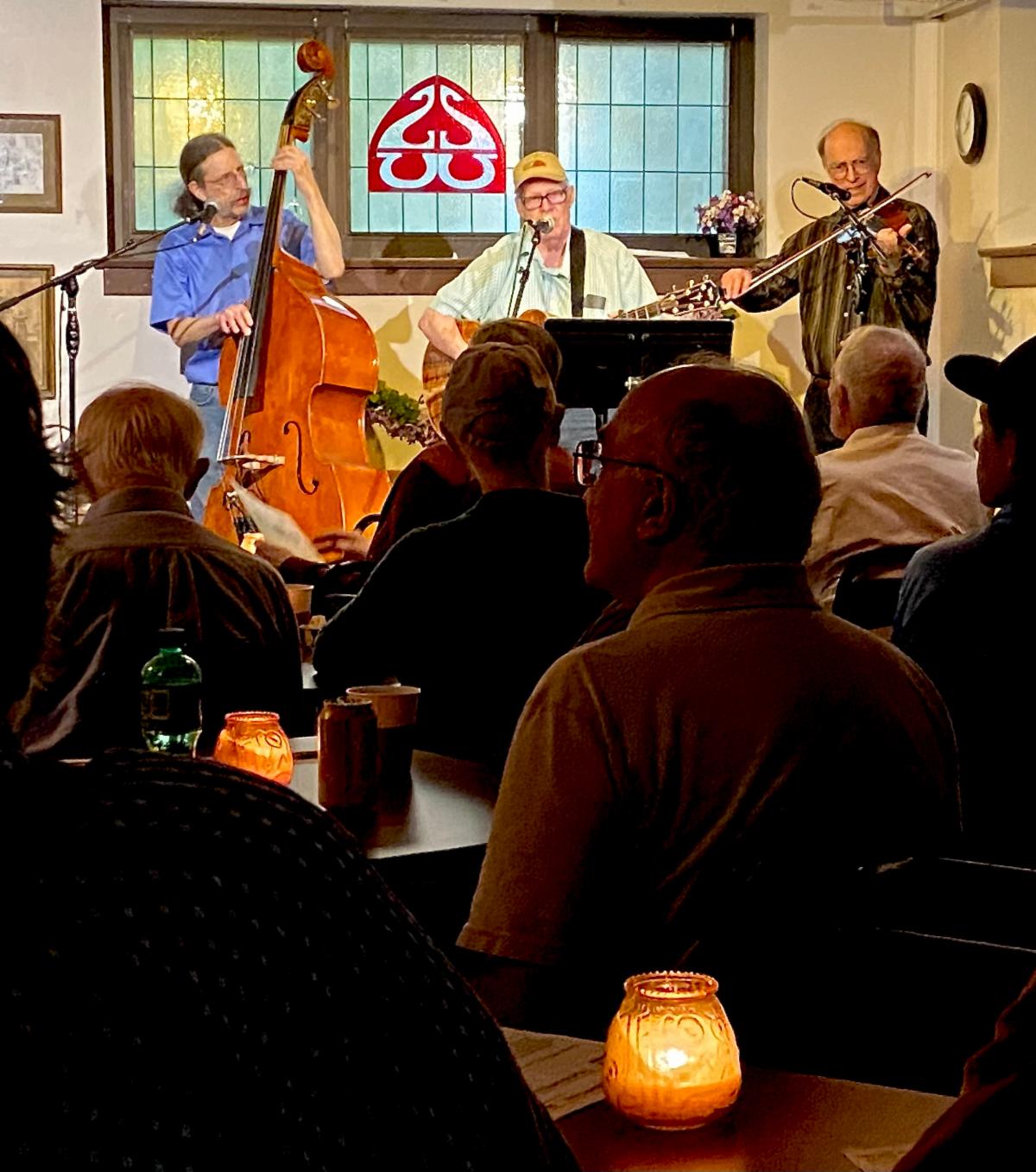
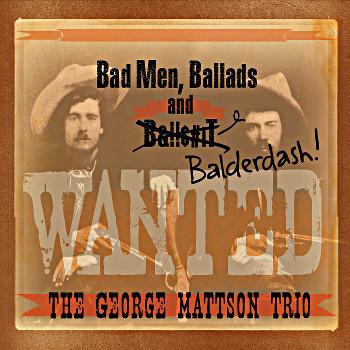
On
June
6, The
Mattson
Trio,
featuring
George
Mattson
and his
backup
musicians
Tommy Re
and Mike
Hazdra,
entertained
an
enthusiastic
crowd.
|
|
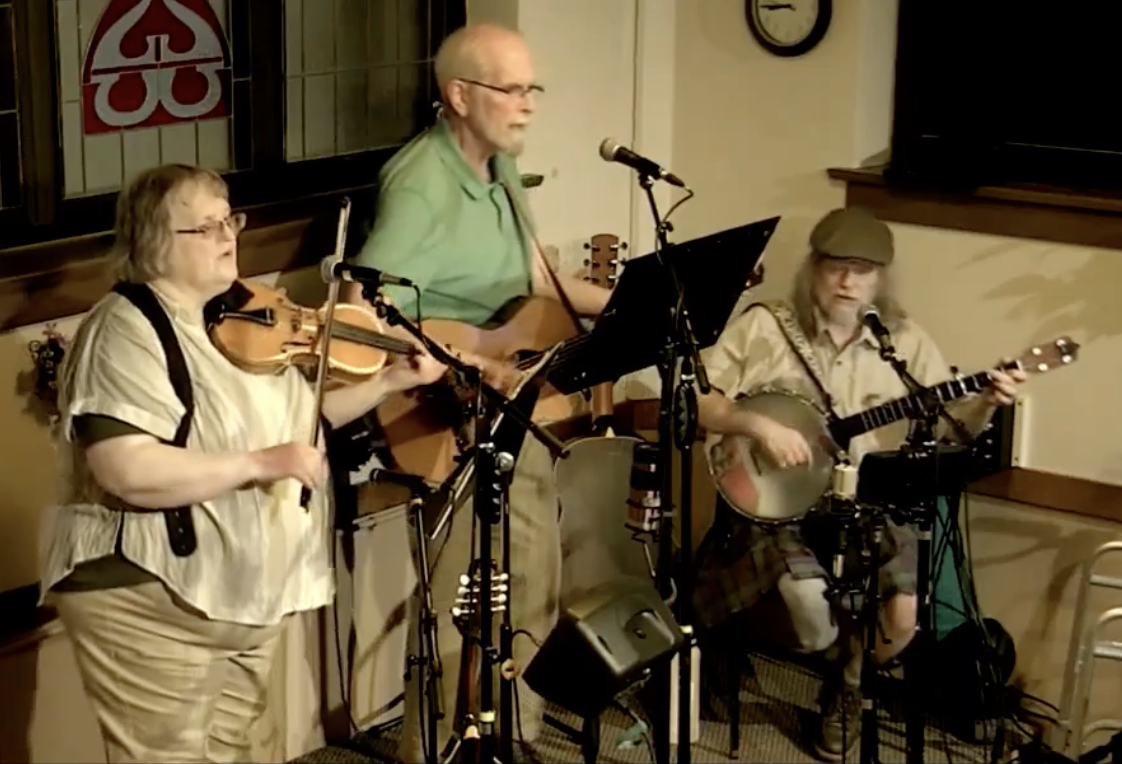
Two
weeks
later
another
local
favorite,
Lonesome
Eagle, took
the
stage.
The trio
includes
long-time
Plank
Road
members
Ron
Leaneagh,
Gregg
Morton
and
Cathy
Jones.
|
|
|
|
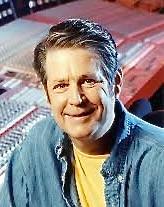
Brian
Wilson
Musician,
singer, songwriter,
record producer and
co-founder of the Beach
Boys, Brian Wilson, died
June 11. He is
considered one of
the most innovative and
significant musical
figures of his
era. He was
82.
Wilson
wrote the majority of
their hits and is
considered a musical
genius for his
songwriting and
recording
techniques. His
orchestral production on
albums
like Pet
Sounds expanded
rock & roll's sonic
palette and utilized the
recording studio as an
instrument. He
became the first pop
musician credited for
writing, arranging,
producing, and
performing his own
material.
His
music was distinguished
for its high production
values,
complex harmonies and
orchestrations, vocal
layering, and
introspective, ingenuous
themes — and his
versatile vocals and
falsetto.
By
the mid-1960s he had
written or co-written
more than two dozen Top
40 hits, including
number-one hits like
“Surf City,” “I Get
Around,” “Help Me
Rhonda,” and “Good
Vibrations.”
Like
many teenagers, he and
his brothers Carl and
Dennis saw rock and roll
as a means to social
success. His father,
Murry, a would-be
songwriter with a
propensity for abuse,
saw his sons' talents as
a ticket to greater
financial success. He
managed the homegrown
group, christened them
The Beach Boys in 1961 —
until Brian broke away
from him in 1964, after
going through his first
nervous
breakdown.
As
one of the first major
rock bands of the 1960s,
The Beach Boys made hits
of subjects like drag
racing, high school
rivalries and, of
course, surfing to
express the empowerment,
freedom and fun many
white middle-class kids
felt in the post-war
boom.
Southern
California became the
mythologized center of
the new American dream .
. . and Brian Wilson’s
music was its
soundtrack
Beyond
the recording studio
where his mastery shone,
Wilson struggled with
lifelong mental illness,
leading him into
isolation at the height
of The Beach Boys'
success. After a nervous
breakdown in 1964, he
withdrew from concert
touring to focus on
songwriting and
production — resulting
in works of even greater
sophistication. One
writer said his greatest
musical works “made room
for the deep melancholy
he experienced, while
evoking an almost
otherworldly beauty — a
soul longing for
peace.”
Wilson
received numerous
industry awards,
including two Grammys
and Kennedy Center
Honors. He was inducted
into the Rock and Roll
Hall of Fame in 1988,
and the Songwriters Hall
of Fame in 2000.
|
|
|
Neighbors?
Wait,
you can’t surf in
St.
Charles, Illinois . .
.
|
|
|
For
several years Brian
Wilson was almost a
"neighbor,” living just
a few miles west of here
in St. Charles. In 1997,
he and his wife,
Melinda, owned a
6,527-square-foot,
five-bedroom French
Country-style mansion in
St. Charles — complete
with a recording studio.
Why
St. Charles of all
places, you ask? It was
so they could work with
and live near his
then-producer, Joe
Thomas. Eventually, the
Wilsons and Thomas had a
falling-out, and the
Wilsons returned to
California for
good.
|
|
|
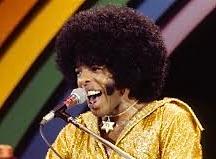
Sly
Stone
Sly
Stone, the eccentric
frontman, singer,
songwriter and producer
of his family
group, Sly &
the Family Stone, died
June 9. He was
82.
He
was a musical visionary
whose charismatic stage
presence and distinctive
vocals redefined the
landscape of pop, funk,
and rock
music. Their early
morning performance at
Woodstock in 1969 was
widely recognized as a
legendary moment.
Born
Sylvester Stewart, Stone
was recording gospel
music with his siblings
by age 8. He was still
in grade school when a
friend misspelled
"Sylvester" as "Sly" —
and the nickname stuck.
By age 11, he was
proficient in keyboards,
guitar, bass, and drums.
In high school, he'd
formed a multi-racial
doo-wop group, and
recorded some singles in
Los
Angeles.
Stone
worked as a DJ and later
as a record
producer. He and
his brother Freddie
merged their own bands
together in 1966 to form
Sly & the Family
Stone. In it, women were
not just vocalists but
also played instruments,
a rarity for the era.
And it included both
black and white
musicians.
Within
a few years, the group
was turning out huge
hits such as "Everyday
People," "Family Affair"
and "Dance to the
Music." Although
they attracted a large
and diverse audience,
Stone was pressured by
the Black Panthers to
fire the white members
of the group. "Sly
always stood up for me,
and in many instances,
he saved my butt,"
recalled saxophone
player Jerry
Marini.
In
the 1970s, Sly Stone's
music got gloomier and
more cynical, reflecting
a world made bleak by
elevated racial
tensions, the Vietnam
War, and the
assassination of Martin
Luther King.
After
playing some of the most
euphoric and politically
charged music that
defined a generation,
the band dissolved, in
part because of Stone's
well-documented drug
abuse. He became
infamous for missing
gigs or showing up late,
as he did for a concert
in Chicago’s Grant Park
in 1970.
By
the 1980s, Sly Stone had
slipped into seclusion.
But in the mid 2000s, he
started to make sporadic
public appearances,
including performing
with his daughter's
band. In 2017, he
received a lifetime
achievement award at the
Grammys.
|
|
|
Tracy
Schwarz
Best
known for his work in
The New Lost City
Ramblers,
fiddler/singer Tracy
Schwarz passed away
on March 29 at age
86.
A
multi-instrumentalist
(fiddle, guitar, banjo,
accordion, and more), he
is regarded as one of
the great musicians of
traditional American
roots music. His
recorded work includes
three Grammy Award
nominations.
Schwarz
took up the guitar as a
pre-teen, mastered the
fiddle in the 1950s, and
immersed himself in the
bluegrass scene in
Washington, D.C. while
attending
college.
After
serving in the Army for
two years, he joined
Mike Seeger and John
Cohen in The New Lost
City Ramblers in 1962.
The group began as
old-time music
revivalists, but soon
absorbed the bluegrass,
folk and Cajun
influences that Schwarz
brought to the
band.
The
group became one of the
mainstays of Folkways
Records, recording nine
albums between 1964 and
2009.
During
his career of over 50
years, Schwarz also
recorded four solo
albums, and along with
Mike Seeger, recorded as
members of The Strange
Creek Singers in
1972.
He
was an enthusiastic
educator of traditional
music styles and made
several fiddle
instruction albums. The
Folkways website said
this:
“He fervently believed
that anyone who was
interested in learning
how to play an
instrument or sing,
could.”
He
had a deep love and
passion for Appalachian
music, and recorded and
performed with countless
traditional musicians —
most recently with his
wife and singing
partner, Ginny Hawker.
His songwriting work
includes “The Poor Old
Dirt Farmer” which was
recorded by Levon Helm
and nominated for Song
of the Year by the
Americana Music
Association in
2008.
Throughout
his career, he worked
tirelessly as a scholar
and teacher of
traditional music
styles, recording
several instructional
records in the
1970s.
The
New Lost City Ramblers
originally included Tom
Paley, who was replaced
by Schwarz in 1962. The
other founders were Mike
Seeger (Pete’s
half-brother), who died
in 2009, and John Cohen
who died in
2019.
|
|
|
Andy's
Music
Trivia
Quiz
Well,
surprise,
surprise,
Fred
Spanuello
missed
only 1,
but then
gets
credit
for it
by
correcting
a brain
fade on
my part.
I would
have put
the
wrong
answer
in for
Q2. Thanks
Fred.
Answers
to April
Quiz:
Q1. What
was on
the
b-side
of Ricky
Nelson's
"Travelin
Man",
and who
wrote
it?
A1. Gene
Pitney
wrote
"Hello
Mary
Lou"
which
Ricky
Nelson
took to
#9 in
May of
1961
after
the
A-side
("Travelin
Man")
went to
#1 in
Apr of
1961.
Q2. What
was the
first
black
girl
group to
have a
#1 BB100
hit? What
was the
group? What
year was
it? Who
wrote
it?
A2. The
Shirelles
took the
Carole
King/Gerry
Goffin
song,
"Will
You Love
Me
Tomorrow"
to #1 in
1960.
The song
was
written
targeting
Johnny
Mathis,
but was
rejected
by
Columbia
records.
The
Shirelles
disliked
the song
because
it
sounded
“too
white,”
but
later
changed
their
mind.
Q3. NAME
THAT
TUNE! -
What
song
begins
with the
words
"Close
Your
Eyes and
I'll"?
A3. "All
My
Loving"
was
released
Jan.
1964 in
the US
on the
"Meet
the
Beatles"
album.
Q4. NAME
THAT
TUNE! –
What
song
begins
with the
words
"When I
was
Young, I
Used to
Wait"?
A4. "Blue
Tail
Fly" is
a
traditional
song
written
by
Decatur
Dan
Emmet in
1848. In
the
1940's,
and the
folk
rebirth
it
remained
popular
by the
various
artists'
recordings: Andrews
Sisters
with
Burl
Ives,
Leadbelly,
Pete
Seeger,
and
others.
Q5. "I've
Told
Every
Little
Star was
a big
1961
hit. Who
sang
it? Who
wrote it
&
when? What
musical
was it
from?
A5. Linda
Scott
sang the
Oscar
Hammerstein/Jerome
Kern
song
that
they
wrote
for the
1932
play,
"Music
In the
Air".
Q6. What
was the
inspiration
for the
Bacharach/David
hit,
"Don't
Make Me
Over"?
A6. After
years of
singing
backup,
Dionne
Warwick
fought
with
Bacharach/David
over
cutting
"Make It
Easy On
Yourself". When
told the
song had
already
been
given to
Jerry
Butler,
she
stormed
out
angrily
saying
to them
"Don't
Make Me
Over". They
recognized
it as a
great
phrase,
wrote
the
song,
and gave
it to
her.
Q7. Ann
Margaret
(Olson)
at age
16
appeared
on the
Amateur
Hour on
12/22/1957. What
beat her
on that
show?
A7. A
contestant
playing
“Granada
“on tea
leaves.
Trivia
Snippet: “GONE
“ . . .
the
fiddles,
banjos,
&
steel
guitars.
Ferlin
Husky's
crossover
hit
"Gone"
(1957 #4
BB100
& #1
BBCW) is
considered
to be
the song
that
inaugurated
the era
called
the
Nashville
sound.
He first
recorded
the song
in 1952
as Terry
Preston
with
steel
guitar,
fiddles,
etc, and
was a
big
flop. In
1957 it
was
revamped
to be a
pop
bluesy
ballad
minus
the
fiddles
and
steel,
and
became a
crossover
smash
hit (#1
BBCW
& #4
BB100). The
CW
industry
underwent
a
drastic
change
in the
following
years
with
Nashville
producers
and
session
musicians
adopting
this
style of
CW
music.
Ferlin
went on
to a
long
career
in
music,
comedy
and
film. As
Simon
Crum he
performed
comedic
versions
of
various
hit
songs.
He
continued
to
perform
into the
1990's
when
health
problems
ended
his
performing
career.
He died
on Mar
17, 2011
at age
of
85.
|
|
|
|
NEW
Trivia
Quiz:
Q1. Who
inspired
Bobby
Darin to
write
"Splish
Splash"?
Q2. NAME
THAT
TUNE! –
What
song
begins
with the
words "
Deep
Down In
Louisiana,
Down"?
Q3. NAME
THAT
TUNE! -
What
song
begins
with the
words "I
keep a
close
watch
on"? Who
sang the
hit?
Q4. What
Connie
Francis
song was
written
by Neil
Sedaka
&
when?
Q5. Jim
Stafford
(Spiders
&
Snakes,
My Girl
Bill)
appeared
on the
Amateur
Hour. When,
at what
age, and
what
song did
he
play?
Trivia
Snippet: “The
Orange
Blossom
Special
“
The
Orange
Blossum
Special
was or
became a
luxury
train,
running
from NYC
to
Miami.
The song
was in
all
probability
written
by Ervin
Rouse, a
member
of a
small
hillbilly
band,
the
Rouse
Brothers,
before
the
train
line
started.
Early on
Erwin
referred
to his
song
(that he
was
always
fooling
around
with) as
his
"crazy
little
fiddle
tune"
(which
got the
Cajun
audience
dancing
like
crazy).
The
group's
manager
Lloyd
Smith
convinced
the rail
line to
use it
for the
line's
christening
since
the
music
actually
sounded
like a
train
rolling
past,
and
named it
the
Orange
Blossom
Special. He
copyrighted
the
song,
and got
the
royalties.
Some
years
later,
Erwin
won back
the
copyright
and
future
royalties
to his
name.
Other
stories
about
the
origin
abound,
but this
one
sounds
the most
authentic.
Johnny
Cash did
a very
popular
cover of
the song
with
lyrics.
Many
bluegrass
bands
have
covered
it as a
bluegrass
instrumental.
Q6. The
Colpix
label
had some
top 40
hits
with
"Hey
Girl"
(Freddie
Scott),
"My Dad"
(Paul
Petersen),
"Goodbye
Cruel
World,"
Conscience
&
Her
Royal
Majesty"
(James
Darren),
and
more. They
changed
the
label
name and
went to
several
top 10
releases
when
what
group
was
signed?
Q7. Jeff
Barry
&
Ellie
Greenwich
wrote
many
hits
including
"DoWah
Diddy
Diddy",
"Hanky
Panky",
and
others.
Jeff
&
Ellie
had some
success
of their
own as a
group.
What was
the
group
name,
and name
two (or
more) of
their
songs?
Q8. What
was the
first
record
to go to
#1 on
both the
American
and
English
charts?
Q9. NAME
THAT
TUNE! –
What
song
ends
with the
words
"Baby,
you're
the
ginchiest".
If
you are
enjoying
the
trivia,
please
send
responses
to
AndyM
@
pictq@yahoo.com
|
|
|
|
A
Special
Thanks
to our
Membership
Contributors!!
Sustaining
Members
-
Betsy
&
Dave
Anderson
-
Dan
Anderson
-
Tom
Henry
&
Marian
Indoranto
-
Keith
&
Irmgard
Olson
- Rich
Pawela
-
Carol
&
Fred
Spanuello
Supporting
Members
($50 -
$199)
-
Anonymous
-
Joe
Bella
-
Bill
&
Mary
Boylan
-
Frank
&
Helene
Clarke
-
Bob
Cordova
-
Tony
&
Ann
Janacek
-
Dottie
&
Gerry
Lee
-
Bill
&
Connie
Lemos
-
Marvin
Lensink
-
Andrew
Malkewicz
-
Chuck
&
Susan
Maltese
-
George
Mattson
- Joseph
Michelotti
-
Marianne
Mohrhusen
&
Mark
Dvorak
-
Gregg
&
Betty
Ann
Morton
-
Bud
&
Mary
Jane
O'Connor
-
Bob
&
Mimi
O'Hanlon
-
Jennifer
&
Jim
Shilt
-
Tobias
Music
-
James
Videbeck
If
you
would
like to
become a
member
or just
need to
renew,
here is
a link
to
the renewal
form
you can
print
and
mail.
|
|
|
|
Bob
O'Hanlon
-
President
reohanlon@gmail.com
(630)
702-0150
Bill
Lemos -
VP,
Secretary
lemos.bill@comcast.net
2025
Board
Members
-
Bethany
DeHaan
-
Treasurer
-
Dottie
Lee
-
Technical
Support
-
Kristen
Fuller
-
Membership
-
Jennifer
Shilt
-
Jim
Gilroy
-
Dave
Humphreys
|
|
Bill
Lemos -
Editor
Dottie
Lee
Bob
O'Hanlon
Jen
Shilt
Kristen
Fuller
Andy
Malkewicz
Wayne
Oestreicher
Jim
&
Jenneine
Gilroy
|
|
|
|
|
|
.gif)
.jpeg)
.jpeg)
.jpeg)
.jpeg)